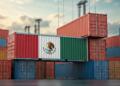
In the run-up to the revision of the United States-Mexico-Canada Agreement (USMCA) , scheduled for July 2026 and whose consultations are expected to begin in September 2025, the automotive sector will be one of the industries at the center of trilateral negotiations, with rules of origin that could redefine supply chains in North America.
In the webinar T-MEC: Review in progress – challenges and perspectives for automotive rules of origin , Bertha Martínez, coordinator of the Bachelor’s Degree in International Logistics at CETYS University , indicated that among the current requirements of the T-MEC for vehicles manufactured in Mexico to enter the US market is the regional content value .
“This means that parts of the car must have been manufactured in Mexico, the United States, or Canada, and in this case, the USMCA requires 75% regional content ,” he stressed, adding that this means that of the total value of the car, 75% “must come from or have been made up of parts that were produced in Mexico, the United States, and Canada.”
Under the North American Free Trade Agreement (NAFTA) , the predecessor to the USMCA, the regional value content was 82.5 percent.
Another requirement is the steel and aluminum content of the vehicles, 70% of which must come from North America, “Mexico, the United States, and Canada, and this gives us the possibility of not only being the condition, but also rolling, sheet metal, ironing, and profiling,” with even stricter rules for these metals, Martínez specified.
Salary is another factor taken into account. Under the USMCA, this requirement establishes a minimum wage of $16 per hour in Mexico, yet the country’s industry “falls far short” of this figure .
Another requirement is auto parts, which the trade agreement establishes as 75% regional content for essential components (engine or transmission) , 70% for primary components, and 65% for complementary components. “So, basically, we’re talking about three-quarters of an engine or transmission being produced in Mexico, the United States, and Canada, and we know we have a very strong supply of these types of components from Asia,” said the specialist, who added that this represents a challenge for the country’s automakers.
Another requirement is that companies must work with a certificate of origin , which was already required under NAFTA. “All free trade agreements have their certificates of origin, but currently, nine mandatory minimum pieces of information are being required from all members of the automotive supply chain,” explained Bertha Martínez.
 For his part, Ismael Plascencia López, professor and researcher at the School of Business Administration at CETYS University, said that the complexity of the value chains in the automotive industry must be understood .
“It’s very difficult when it comes to complying with requirements and crossing customs, because we’re talking about a vehicle that can be assembled in Canada, for example, the modules cross several times from the United States to Canada, from Canada to the United States, and back again. So, thinking about the issue of how tariffs are applied will be very cumbersome administratively speaking, and that’s the great challenge we face from the perspective of regional content, both labor and what the auto parts represent,” he explained.
The most-favored-nation option
Given the complexity and costs associated with complying with the USMCA’s rules of origin, some automotive companies are opting for the most-favored-nation (MFN) approach , a principle established by the World Trade Organization (WTO) that treats all trading partners equally and is essential for promoting the stability of global trade.
Bertha Martínez pointed out that in 2019, 96% of automotive exports qualified for 0% tariffs under the USMCA, but by 2023, that proportion had dropped to 84%, while 16% opted to pay the 2.5% MFN tariff currently imposed by the United States on vehicle imports.
“We’re seeing an increasing number of countries opting to pay this most-favored-nation tariff, leaving the USMCA issue behind, because compliance is cost-effective for companies because it obviously involves documentation, auditing, and restructuring the supply chain,” he emphasized.
In his presentation, Alfredo Valadez, professor and researcher at the School of Business Administration at CETYS University, noted that the United States has had a trade deficit for just over 30 years, a situation underlying President Donald Trump’s decision to impose tariffs. The specialist also noted that Mexico’s trade dependence on its northern neighbor exists.
“The economic threads of Mexico’s foreign trade depend on a single destination, unfortunately,” he stressed.
The USMCA review represents an opportunity for Mexico to negotiate strategically , not only defending the automotive sector but also promoting electromobility and building more resilient supply chains. However, the review’s success will depend on negotiators’ ability to address the complexities, challenges, and alternatives with the goal of creating a scenario that benefits all three countries.
Comment and follow us on X: @Eliseosfield / @GrupoT21