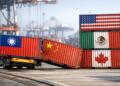
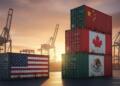
VERACRUZ, VER.- Starting October 14, the global maritime landscape will change abruptly: The United States will apply port tariffs to vessels of Chinese origin or ownership, a measure that could redefine trade flows and maritime routes, once again opening up space for Mexico as a transshipment logistics alternative . In parallel, China has responded with a mirror tariff scheme that will also go into effect on that same date, deepening tensions on one of the least explored fronts of the dispute between the two powers: control of global maritime infrastructure.
Washington’s decision, driven by the Donald Trump administration, seeks to reduce dependence on Chinese shipbuilding and revive the US industry. All vessels built in China—regardless of the shipping company’s nationality— will pay $80 per net tonnage per voyage, while non-Chinese operators of vessels manufactured in that country will pay up to $154 per 20-foot container (TEU) . The measure will directly affect the world’s top 10 shipping lines, which could assume an aggregate cost of $3.2 billion by 2026, according to a recently published S&P report.
China was quick to respond. On October 10, it announced that it would also impose port fees on US vessels, whether owned, operated, flagged, or built . The scheme will be progressive: 400 yuan (approximately $56) per net ton in October 2025, gradually rising to 1,120 yuan ($157) per ton in 2028. With this mechanism, Beijing establishes a tariff mirror that seeks to neutralize the economic blow and send a strong political message: the seas are also a terrain of strategic confrontation.
For Carlos Martner, Integrated Transport and Logistics Coordinator at the Mexican Institute of Transport (IMT) , who participated in the 29th Annual Congress of Shipping Agents of the Mexican Association of Shipping Agents (Amanac) , the impact will be profound and could reconfigure maritime networks on a global scale. “These tariffs (from the United States) will apply to all Chinese-made vessels, regardless of the shipping company, and also to those operated by Chinese shipping companies, such as Cosco Shipping , for example,” he explained. He recalled that, according to data from the United Nations Conference on Trade and Development (UNCTAD) , China accounts for 55% of ship manufacturing in gross tonnage, and if Korea and Japan are added, the percentage reaches 95% . “The others do not exist,” he emphasized, sizing up the scope of the measure.
Origin of the ships of the main shipping lines
The blow will not be minor: virtually the entire fleet that transports automobiles to the United States, the so-called car carriers or roll-on-roll-off , will also be subject to these tariffs. However, beyond the immediate costs, Martner warned that shipping companies will reorganize their fleets to reduce exposure, redirecting vessels linked to China to alternative routes. “Obviously, shipping operators will organize their fleets and divert vessels associated with China to routes other than those originating in or destined for the United States (…) they seek to reduce exposure,” he noted.
In this scenario of forced operational adjustments, Mexico could emerge as a strategic transshipment point. “Some analyses suggest that vessels diverted through alternative transshipment hubs could generate benefits for some ports in Canada, Mexico, and the Caribbean ,” Martner stated. The logic is clear: if deep-draft vessels avoid direct calls at U.S. ports to avoid tariffs, they could unload at Mexican terminals and complete the journey by land to the United States.
A similar opportunity arose in the midst of the recent COVID-19 pandemic and the congestion that arose at the ports of Long Beach/Los Angeles, where the company SPARX Logistics, together with the then Kansas City Southern de México (now Canadian Pacific Kansas City ), transported merchandise from Asia in a unit train from the port of Lázaro Cárdenas (on the Mexican Pacific coast) to Chicago, Kansas City and Houston, in the United States.
Furthermore, the current US measure includes exemptions for vessels under 4,000 TEUs and for vessels arriving empty to load exports. According to Martner, “the combined effect could lead to various outcomes, from the reorientation of trade routes with longer distances traveled to a reduction in trade volumes. But also, given that these measures stimulate regionalized trade, they may strengthen the concept of nearshoring .”
This point is key: if regional trade in North America strengthens, short -sea shipping could gain new importance. “Shorter regional trade routes will be able to boost short-sea shipping connections with smaller vessels. That’s why some analysts say feeder services will be on the rise,” Martner noted, alluding to a possible expansion of feeder services connecting Mexican ports with U.S. terminals.
However, Mexico’s potential is not automatic. The ability to take advantage of this realignment will depend on efficient and sufficient port infrastructure, flexible customs regulations, and bilateral logistics coordination. Tensions between Washington and Beijing could translate into tangible opportunities, but only if public and private actors can articulate swift and strategic responses . Otherwise, the country could be left out of a transformation that has already begun to take shape on the Pacific coast.
Comment and follow us on X: @EnriqueDuRio / Sent / @GrupoT21