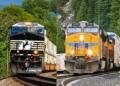
The potential merger between US railroads Union Pacific (UP) and Norfolk Southern (NS) would bring Mexico the possibility of shifting more freight from road transport to rail, mainly in the border states , as well as starting new intermodal services between the two countries.
In their application submitted last December to the State Transportation Board (STB) , the railroads justified their merger by mentioning, among other benefits, the reduction of congestion on freeways and impacts on roads , which would create a more resilient supply chain and improve the competitiveness of U.S. ports against those in Canada and Mexico as routes to North America for international shipments.
For the intermodal market between these countries, the opportunity would be established to launch a scheduled service to the east of the United States from these points and serve the cross-border transport market .
“It is expected that the enhanced service offerings of the combined rail will induce significant demand for long-distance intermodal service across the integrated network,” they stated in the document.
Carlos Barreda Westphal, director of Ferroviaria.mx , emphasized that the export sector, both Mexican and American, could benefit from this merger “in terms of the quality of service they currently receive, with fewer interconnections depending on the origin and destination between both countries.”
He commented that while no major changes are expected from UP regarding border crossings, he noted the importance of its shareholding in Grupo México Transportes (GMXT) , “which could benefit Ferromex in terms of the strategic value of its alliances and its railcar exchange operations in Piedras Negras, El Paso, Nogales and Mexicali.”
Humberto Vargas, Chief Commercial Officer of Crossdock , said that, given Union Pacific’s position in Mexico, “we should expect a greater benefit from a merger of this nature given their presence in the country .”
According to the document and based on projected traffic flows, UP and NS designed six new pairs of intermodal trains that would operate seven days a week, including the Texas/Mexico-Northeast (ZMXCX/ZCXMX) between Port Laredo and Croxton via New Orleans, to meet projected demand for traffic moving between Mexico and Texas and the Ohio Valley, Southeast and Northeast.
“Eastbound, ZMXCX will depart Port Laredo with blocks for Croxton, Atlanta, Charlotte, Columbus (Rickenbacker), and Cincinnati (Sharonville), enabling service from Mexico and Texas to key markets in the Ohio Valley, Southeast, and Northeast. In San Antonio, the train will pick up blocks for Croxton, Atlanta, and Greencastle. In Houston, the train will pick up blocks for Greencastle, Morrisville, and Charlotte before continuing to Atlanta, where it will unload blocks destined for the Southeast and Ohio Valley and pick up blocks destined for the Northeast. From Atlanta, ZMXCX will continue north, unloading and picking up traffic in Greencastle and Rutherford before terminating in Croxton,” the companies explained.
The railroads also indicated that two years ago, the STB approved the merger that gave rise to Canadian Pacific Kansas City (CPKC) ; however, the ports and domestic markets of the United States remain divided into east and west railroads, so with the new company that UP and NS would form, they “could offer American carriers, workers, and communities the same benefits that Canada and Mexico enjoy and that our trucking competitors have offered for decades.”
Although the STB stated that it rejected their request because the document was incomplete, it pointed out that UP-NS will have until April 30 to submit a new application for their merger.
Humberto Vargas noted that this is not the first time the STB has requested additional information to evaluate this type of request.
“This is somewhat normal behavior, and it’s a merger that is highly subject to public scrutiny. The merger analysis is being approached with caution,” he concluded.
Comment and follow us on LinkedIn: @Evangelina del Toro / @GrupoT21