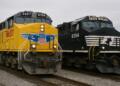
The Surface Transportation Board (STB) has received a notice of intent regarding the proposed merger between Union Pacific (UP) and Norfolk Southern Corporation (NSC) , initiating the regulatory review process for the combination of two Class I railroads.
The petitioners stated that on July 28, they entered into an agreement and plan of merger under which UP, through a wholly owned subsidiary, would acquire all of NSC’s outstanding shares in exchange for consideration consisting of NSC’s common shares and cash.
“If the STB approves the upcoming application, and upon receiving shareholder approval and meeting customary closing requirements, NSC would become a direct, wholly owned subsidiary of UP. The applicants state in their notice of intent that they do not contemplate the use of a voting trust,” he stated.
Under the board’s key merger regulations, the notice of intent, also known as a pre-filing notice, initiates a timeline for both railroads to file a merger application within three to six months .
In this regard, the STB received the notification on July 30, and the applicants declare that they intend to submit their application on or before January 29, 2026 .
The agency must publish a notice of the pre-filing notification in the Federal Register within 30 days. If an application is timely filed, its completeness will be determined and a procedural schedule for the review process will be issued.
According to their STB filing, the applicants believe that a combination of UP and NSC represents an unprecedented opportunity to create America’s first transcontinental railroad, transforming the American supply chain, boosting the industrial strength of American manufacturing, and creating new sources of economic growth and job opportunities.
“UP and NSC have highly complementary networks. Current customers of both railroads will benefit from a faster, more efficient, and more reliable network that offers single-line service from coast to coast, connecting approximately 100 ports and nearly every corner of North America. This combination will provide new rail options for shippers in regions where rail connections are less efficient, such as the Ohio Valley and on both sides of the Mississippi River, creating a more accessible, sustainable, and lower-cost supply chain for manufacturers and consumers,” they noted.
They also stated that the merger will result in increased rail volume, generating additional employment opportunities and allowing them to compete more effectively with Canadian railroads to regain freight volume from the United States.
It’s worth remembering that on July 29, UP and NSC announced a merger agreement, valued at $85 billion , which would make it the first transcontinental railroad in the United States.
According to the companies, the combination will create a rail network worth more than $250 billion, with a network of 50,000 miles (just over 80,000 kilometers) serving 43 states from the East Coast to the West Coast of the United States, and connecting to approximately 100 ports and reaching nearly every corner of North America.
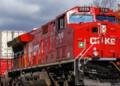
The STB’s last merger approval came in 2023, when it agreed to the combination of Canadian Pacific (CP) and Kansas City Southern (KCS) (now Canadian Pacific Kansas City (CPKC) , although it imposed an unprecedented seven-year oversight period containing numerous conditions intended to mitigate environmental impact, preserve competition, protect rail workers, and promote efficient passenger rail.
Upon learning of the news, Keith Creel, CPKC’s president and CEO, stated that they will continue to pursue their value proposition, as “it is a unique and powerful network, the only one connecting the United States, Canada, and Mexico, a network that will continue to drive differentiated growth , and a management team that undoubtedly has the track record of execution to back up our actions with our words.”
Therefore, he said, the value and strength of his network “puts us in a very unique position that has allowed us to produce what we’ve produced in the last two years; that doesn’t change. And similarly, our multi-year outlook and value proposition haven’t changed. The team and the network will continue to deliver differentiated results.”
“We are dealing with a regulator who takes their job very seriously. They will be pragmatic. They will be diligent. They will be fact-based. I believe they will base their decisions on the facts that unfold, the truths that are represented and presented, and they will be debated and discussed in a very thorough manner to achieve the right results,” he said.
However, he emphasized that in intermodal services, if the merger goes through, the alliance would not threaten their single-line segment. Furthermore, they would not have a network in Canada , “that’s where we’re strong. We play to the strength of our network. We have the shortest routes in the most key markets, and we do extremely well with premium service in Canada.”
Likewise, he emphasized, the same applies to the Chicago-to-Mexico route, whose proposal doesn’t affect the route. “I don’t feel threatened by that at all, but this isn’t just about a single-line service. This is about much more than that. And again, all the facts need to be made known and understood in relation not only to UP and NSC and their customers, who would benefit from this, but also in relation to a duopoly system of railroads in North America. The outcome of that will be determined by the regulator.”
Comment and follow us on X: @evandeltoro / @GrupoT21