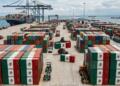
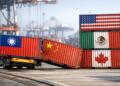
Global trade is facing a climate of uncertainty, which has become a “new tariff,” raising costs, shaking financial markets, and hitting developing economies hardest, the United Nations Conference on Trade and Development (UNCTAD) warned .
According to the organization, the Global Trade Policy Uncertainty Index reached record levels in the first quarter of 2025, driven by the growing unpredictability that has become a global feature.
The index, which was near zero last year after peaking at 10,000 points in 2023, rose to more than 27,000 points during the first half of 2025, according to UNCTAD’s latest World Trade Update .
 Although global trade has always faced complicated situations, such as pandemics and geopolitical divisions, the current climate of mistrust due to the tariff war has made uncertainty “systemic.”
“Businesses face difficult choices: stockpile goods, divert shipments, or pay higher transportation costs. In early 2025, the volatility of US imports increased compared to the previous year, even before the tariffs took effect, as businesses rushed to adapt. The cost of uncertainty itself often exceeds the tariff,” UNCTAD stressed.
Given this scenario, small exporters and developing economies are bearing the brunt of the impact, with limited financing and logistics to cushion the impact .
Uncertainty also poses a risk to financial and macroeconomic stability, as exchange rates fluctuate, capital flows contract, and borrowing costs rise.
“For developing countries, where access to commercial financing is already scarce, this translates into restricted credit and reduced investment. With global interest rates still high, the additional burden of unpredictability deepens fiscal fragility, limiting governments’ ability to finance growth and social development,” he said.
Uncertainty also erodes trust and cooperation , which UNCTAD considered the “most damaging” aspect, as when policies are unclear or rules are applied selectively, governments resort to unilateral measures that trigger retaliation. “This cycle fuels volatility in supply chains .”
While advanced economies recorded stable import trends, developing countries experienced more pronounced fluctuations in early 2025 , indicating how the most vulnerable economies are also the most exposed.
“The cost of unpredictability is evident: volatility punishes those least able to absorb it,” the organization emphasized.
Despite the climate of uncertainty and volatility in global trade, UNCTAD remained positive and noted that there are ways forward.
“Diversifying markets, strengthening trade agreements, and providing businesses with advance notice of policy changes can reduce risk. Above all, restoring stability and predictability is essential for businesses to invest, for countries to grow, and for trade to fulfill its role as an engine of development,” he encouraged.
The tariff policy promoted by the United States represents a hindrance to global trade, especially due to the uncertainty it generates among investors, who are seeking stable markets to invest capital.
The 90-day extension granted by the United States to Mexico for the collection of tariffs represents a “respite,” although it does not free the country from the uncertainty that will grow as the days go by and this period expires.
Comment and follow us on X: @GrupoT21