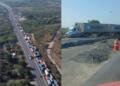
More time on the roads, higher fuel consumption and an increase in carbon dioxide (CO₂) emissions are the effects of the increased level of vehicular congestion in 2025, which has become a problem for major cities around the world, seeking to maintain an optimal flow in commutes.
Minutes that turn into hours and time lost in traffic jams is the scene that is repeated daily in various cities , whose traffic has exceeded the road infrastructure such as bridges and highways, generating chaos, in addition to other social factors such as the blockades in Mexico City.
According to the TomTom Traffic Index 2025 analysis , the country’s capital once again ranked first as the city with the most traffic congestion in the world in 2025 , with a level of 75.9% , which represented 3.6 percentage points less than in 2024.

This weighting represented the highest level among 492 cities analyzed by the Dutch company, which specializes in vehicle navigation systems, and revealed that the average speed of circulation was only 17.4 kilometers per hour (km/h) in Mexico City .
The average distance traveled in 15 minutes was 4.4 kilometers (km), which caused the population to lose 184 hours in traffic during 2025 , equivalent to seven days and 16 hours, although this represented a decrease of one hour and 16 minutes compared to 2024.

For a 10 km journey, the average travel time was 34 minutes and 29 seconds; the average speed during peak hours (a period when congestion and crowding occur, mainly in traffic and public transport) was 13.5 km/h, while the average speed on Mexican highways was 31.7 km/h .
According to TomTom’s analysis, May 28, 2025 was the worst day to travel in the country’s capital , as the congestion level at 3:00 p.m. was 167%, while the distance traveled in 15 minutes was only 2.6 km.
After Mexico City, Bengaluru, India, ranked second, with a congestion level of 74.4 percent. Dublin, Ireland, came in third, with 72.9 percent . “Dublin also ranked as the sixth slowest city in the world, with a travel time of three minutes and 27 seconds per kilometer.”
“These cities epitomize the challenge of traffic and congestion, and often rank highly in the Traffic Index. While traffic in these locations is among the densest on the planet, many cities exhibit far more alarming trajectories,” TomTom stated.
Traffic in other cities in Mexico
The analysis also revealed that other Mexican cities have high levels of congestion. After the capital, Guadalajara, Jalisco, showed a 2.9 percentage point increase compared to 2024, reaching 63.3% , equivalent to 126 hours lost on the roads during 2025.
Monterrey, Nuevo León, with a congestion level of 48% , registered an increase of 0.9 percentage points last year over 2024; the time lost on the road was 89 hours.
Tijuana, Baja California, experienced a congestion level of 47.4% , 2.2 percentage points higher than in 2024, with an average of 72 hours lost in traffic. León, Guanajuato, showed a traffic congestion level of 42.5% during 2025 , an increase of 0.6 percentage points compared to 2024. Residents lost 85 hours in traffic.
Ecatepec, State of Mexico, and Puebla, Puebla, showed congestion levels of 41.8% and 41%, respectively. Ecatepec saw a decrease of 1.1 percentage points compared to 2024. Drivers spent an average of 58 hours stuck in traffic jams. The city of Puebla showed a decrease of 2.4 percentage points in 2025 compared to 2024, with 94 hours spent in traffic.

According to the TomTom study, as in 2024, traffic continued to worsen in 2025, resulting in most cities around the world experiencing increased congestion and travel times , which translated into slower mobility.
With the aim of reducing the effects of vehicular traffic, specialists have indicated that one of the measures is the use of public transport and bicycles , so investment and improvement of the infrastructure for these means of mobility is necessary.
Another solution is the implementation of shared transport systems , which would help reduce the number of vehicles in large cities, whose chaos also affects the economy, since slow traffic causes significant losses in productivity.
Comment and follow us on X: @GrupoT21