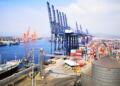
A recent container unloading operation at the port of Topolobampo marks a turning point in the logistics history of this Mexican Pacific terminal. It’s not just a one-off maneuver, but a concrete sign that the port is beginning to integrate into intermodal flows and supply chains that, until now, had been foreign to it. Behind this operation is Conekta Intermodal , a company that has taken on the role of stevedoring operator and, in doing so, is testing a broader logistics model in the field.
The unloading marks the company’s sixth spot vessel operation and, on this occasion, includes an additional strategic element: the incorporation of its own equipment . “This is our sixth spot vessel operation. And we received the new equipment that we previously rented; now it’s ours, the reach stacker ,” explained José Luis Castro, CEO of Conekta Intermodal, in an interview. This is a significant decision, as it represents a structural change in the company’s operational capacity. “For me, this is a very important leap because it now allows me to provide and offer the required service with our own equipment and acquire more of this equipment according to market demand,” he added.
The vessel arrived from Antwerp, Belgium, under a contract with BBC Chartering, carrying 160 TEUs (20-foot equivalent units) and approximately 5,000 tons of specialized equipment destined exclusively for the construction of an industrial plant in northern Sinaloa. Castro emphasized that this is project cargo, linked to a factory currently under construction and part of a wave of industrial investments beginning to materialize in the region.
Beyond this specific transaction, the executive offered a broader interpretation of Topolobampo’s current situation. From his perspective, the nearshoring (relocation of production lines) discourse has found one of its few real footholds in this region. “There’s a lot of talk about nearshoring , but the only place we see it is here,” he stated . This argument is based on ongoing projects, such as ammonia and green methanol plants, as well as energy developments in the area, which together represent multimillion-dollar investments and are already resulting in the physical movement of machinery and materials.
In this context, Conekta Intermodal not only operates as a port stevedoring company, but also develops a long-term strategy to capture cargo that currently flows through other Pacific ports and even those on the US West Coast. Castro revealed that they currently have around 40 letters of intent from clients with goods moving through alternative terminals . The objective is clear: to divert these flows to Topolobampo and connect them with the US market, particularly Phoenix, Arizona, where the company’s nerve center is located.
The logistics strategy aims to reduce the costs and risks associated with congestion at ports like Los Angeles and Long Beach. “The idea is to avoid the congestion that exists in Los Angeles and use this route to reach Phoenix,” Castro stated. To this end, the company is advancing negotiations with shipping lines to establish a feeder service connecting Topolobampo with Lázaro Cárdenas and Manzanillo, as well as pursuing rail and highway agreements that will allow for competitive transit to the southwestern United States.
The project also includes the development of its own infrastructure outside the port area. Conekta Intermodal has a contract with the company Parques Industriales de Topolobampo for the use of a 12-hectare paved external yard, while it is progressing with the construction of a Strategic Bonded Warehouse that will be developed in a modular fashion, with an initial phase of 12 hectares and the potential to expand to up to 400 hectares. “We are going to do it in a modular way. First 12 hectares. And then we will grow from there,” explained Castro, detailing that the containers can go directly to the plant or pass through the yard, depending on the client’s needs.
This combination of operational decisions, investments in equipment and infrastructure, and the acquisition of logistical demand is beginning to redefine Topolobampo’s role within the national port system . Added to this is institutional support and the port’s inclusion in federal industrial development programs, factors that enhance its attractiveness for new productive investments.
Thus, the recent unloading of containers is not an isolated event, but rather the tangible expression of a strategy that seeks to integrate Topolobampo into global supply chains, with an intermodal approach, geared towards the US market and anchored in industrial projects already under construction. In Castro’s words, nearshoring has ceased to be an abstract promise and has begun, at least in this port, to take operational form .

Comment and follow us on X: @EnriqueDuRio / @GrupoT21