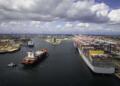
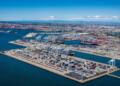
Tariffs imposed by the United States on imported goods impacted cargo movement at the port of Long Beach, California, which last May registered a drop of 8.2% , processing 639,160 20-foot containers (TEU) , compared to the same month last year.
“We are monitoring the development of new trade policies and the impact on our longshore workers and others throughout the supply chain,” said Bonnie Lowenthal, president of the Long Beach Port Commission, regarding the reported decline in May.
In the fifth month of the year, imports fell 13.4% to 299,116 TEUs, the port reported in a statement.
Exports also showed a downward trend, with 82,149 TEUs moved , which meant an 18.6% annual decrease, while empty containers circulating through the port increased to 257,895 TEUs, 3.2% more compared to May 2024.
Despite the negative figures for the fifth month of 2025, Port of Long Beach officials expect that a temporary pause in tariffs “will likely trigger an increase in cargo by the end of June.”
“We remain cautiously optimistic that import cargo will rebound in late June and July, just in time for peak shipping season, when retailers stock shelves with back-to-school supplies and begin preparations for winter break,” said Mario Cordero, executive director of the Port of Long Beach.
In the January-May 2025 period, the port handled 4,042,228 TEUs , representing a 17.2% increase compared to the same period in 2024.
Cordero noted that although commercial uncertainty persists, investments in port infrastructure continue. “While uncertainty persists for the business sector, the Port of Long Beach continues to invest in rail and terminal improvements to move cargo efficiently, safely, and sustainably,” he said.
As the United States’ primary gateway for trans-Pacific trade, the port handles more than $300 billion in annual trade and supports 2.7 million American jobs, including 691,000 in Southern California.
Over the next 10 years, the port plans $3.2 billion in capital improvements , which will be used to increase capacity, competitiveness, and sustainability.
In terms of sustainability, the port, which was named by industry leaders as “The Best Seaport on the West Coast of North America” for the sixth consecutive year in 2024, celebrates in 2025 the 20th anniversary of the Green Ports Policy , which has led to programs to improve air and water quality, protect marine wildlife, and implement sustainable practices.
Comment and follow us on X: @GrupoT21