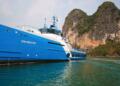
SAAM celebrated a historic milestone for Chile and Latin America with the christening of the Trapananda, the region’s first electric tugboat , a key step in the maritime sector’s energy transition and a concrete step toward more sustainable operations.
The vessel is distinguished by its zero direct carbon dioxide (CO₂) emissions and its ability to reduce underwater noise radiation, protecting marine life and actively contributing to the decarbonization of the port sector. Thanks to a strategic collaboration with Enap , the electric tugboat will operate in one of the southernmost terminals in the world—Puerto Chacabuco, in the Aysén Region—supporting vessel berthing and unberthing maneuvers.
“The arrival of the Trapananda marks a turning point for our industry. We are moving forward with conviction toward cleaner, more efficient, and environmentally friendly operations. This project represents a vision for the future: we develop solutions that not only tow and assist vessels, but also drive a shift toward a truly sustainable logistics chain. Along this path, we have found in Enap a partner with a shared vision,” said Macario Valdés, General Manager of SAAM.
Operated by a local SAAM team trained in high-precision maneuvers, this unit joins the two electric tugs the company already has in Canada.
“At Enap, we have a clear mandate: to ensure a reliable, efficient, and quality energy supply for Chile. But today, that mandate demands more than compliance; it demands transformation. In our 80-year history, we reaffirm our commitment to the country by innovating responsibly and with a vision for the future. The incorporation of this tugboat, the result of a virtuous alliance with SAAM, demonstrates that when the public and private sectors work decisively together, it is possible to make progress on complex challenges such as decarbonization. This step is a concrete sign that we can indeed accelerate the energy transition through collaboration and action,” added Gloria Maldonado, Chairwoman of Enap’s Board of Directors.
The christening ceremony for this vessel, held at the Empormontt Passenger Terminal , brought together local authorities, executives from both companies, and representatives of the maritime port community, marking a key moment in the evolution toward a cleaner and more efficient industry.
Trapananda
The tugboat was named Trapananda in honor of the ancient name for Chilean Patagonia , a remote, untamed land covered in dense jungle, which for early Spanish explorers represented an uncharted and challenging territory.
With this name, SAAM seeks to pay tribute to the history, strength, and unique beauty of southern Chile , where this ship will begin operations.
Technical details
It measures 25 meters in length and 13 meters in width. It has a bollard pulling capacity of over 70 tons , enabling it to assist large vessels in challenging port conditions. It is equipped with two 2,100 kW electric azimuth thrusters, powered by a 3,616 kWh lithium-ion battery, distributed across two compartments.
Its design —created by Robert Allan Ltd. and built by the Sanmar shipyard in Turkey— is optimized to reduce hull resistance while maximizing energy efficiency. The batteries, remotely monitored by the manufacturer in Norway, have an estimated lifespan of 10 years.
Comment and follow us on X: @GrupoT21