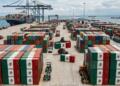
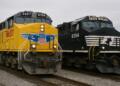
The Mexican Railway Association (AMF) predicted that the railroad industry will not see growth in freight movement by the end of this year , due to the impact of reduced activity in various sectors.
“While this has been a year in which we have noticed some slowdown in some segments, in others we have seen resilience and continued growth, and with this we hope to close out the year similar to 2024,” said Francisco Fabila, president of the AMF.
In an interview with the media at the XXII ExpoRail , organized by the AMF, he reiterated that the impact is due to a general slowdown, not just the US tariff policy .
He noted that segments such as construction, steel, and cement have reported a decline in cargo movement within the country; however, intermodal and cross-border cargo have increased.
“This shows us that, tariffs or not, the dynamics at the border continue, specifically in intermodal freight. The region and supply chains are intertwined; today, the need for products whose inputs come from all three countries (Mexico, the United States, and Canada) continues. We continue to see the exchange,” he said.
Fabila also commented that they will be closely monitoring the review of the United States-Mexico-Canada Agreement (USMCA) , primarily regarding border crossings and border security, as well as communication, efficiency, and standardization of processes and authorities.
“Much of what will be discussed impacts the railroad because it is the cargo that travels through this transport system, whether automotive or steel. Many of our users will have important points that will influence the negotiations, and we as a sector will be very attentive to the commercial aspect at border crossings and the border,” he emphasized.
In this regard, he commented that they are working with the Mexican National Customs Agency (ANAM) to identify the challenges faced at the various border crossings, as well as to implement best practices, such as joint inspections and international crews.
During the ExpoRail opening, Fabila said the sector is experiencing a period of strength , and has modernized its infrastructure with efficiency, technology, and regulatory standards from Canada and the United States.
 He mentioned that the industry’s share of freight movement has doubled, reaching a historic record of 132 million tons in 2024 , and that investments totaling more than $15 billion have been made in fleet modernization, infrastructure renewal, and technology adoption.
“Railroads have been, continue to be, and will be a great ally of nearshoring , allowing Mexico to take full advantage of the relocation of production chains,” he noted.
For his part, Alejandro Malagón, president of the Confederation of Industrial Chambers (Concamin) , highlighted that the sector faces challenges such as insecurity, mainly due to the incidence of theft, although vandalism has decreased.
“The challenges are not obstacles, but rather pending tasks that we must address because the solution depends on the railroad and its continued competitiveness for decades to come,” he noted.
Comment and follow us on X: @evandeltoro / @GrupoT21