In Veracruz, history has never been mere scenery: it’s a driving force that continues to propel the port forward. That’s why, when Hutchison Ports ICAVE decided to celebrate its first 30 years of operation, it opted not for a traditional corporate retrospective, but for an exercise in critical reflection. The result was “Veracruz, Port of Centuries,” a documentary that explores five centuries of maritime activity to understand how the port became a backbone of Mexican foreign trade.
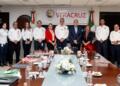
The premiere at Foro Boca brought together the port community, academia, government officials, and business leaders, in a gesture that sought more than just to commemorate a date: to connect past, present, and future around the port’s strategic role. The stage setting underscored the tone of the production: an aesthetic and technical reflection that delves into Veracruz’s logistical identity and its constant process of transformation.
The documentary is structured in six chapters that trace the history of the port from colonial activity in San Juan de Ulúa to its contemporary expansion into Bahía Norte. The collective narrative, featuring historians, specialists, and key figures in the sector, reconstructs the port’s major milestones and the moments when infrastructure, public policy, and global dynamics redefined its course. The arrival of Hutchison Ports ICAVE in 1995 emerges as a turning point that modernized container handling in the Gulf of Mexico.
Among the testimonials, those of Susana Díaz Virgen , general manager of ICAVE, and Jorge Lecona , director of Hutchison Ports in Mexico, Latin America and the Caribbean , stand out, who share the vision of the project and its impact for Veracruz.
More than a chronological overview, the piece offers a critical analysis of port development. It highlights technological advancements but also acknowledges the tensions inherent in operating in an environment where commercial interests, regulatory policies, logistical demands, and the expectations of an economy dependent on the constant flow of goods converge. The documentary presents a diverse port community that has sustained this evolution: operators, specialists, technicians, and professionals who embody the port’s transformation.
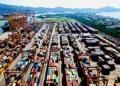
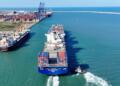
The production report also underscores ICAVE’s operational leap over three decades: from four hectares to a state-of-the-art terminal with a capacity of 1.3 million TEUs (20-foot equivalent units) annually , equipped with Super Post Panamax cranes—including automated units—autonomous tractor-trailers, and traceability systems based on RFID, OCR, and real-time monitoring. It’s not just about infrastructure, but a technological ecosystem designed to compete on a global scale.
The documentary also highlights the terminal’s economic importance: handling over 30% of the nation’s containerized cargo, providing thousands of direct and indirect jobs, and representing a cumulative public-private investment exceeding 60 billion pesos. It also addresses the challenge ahead: a sustainability strategy aimed at complete decarbonization by 2050, a goal that necessitates a complete rethinking of the port’s operational and energy model.
With an educational focus, the piece aims to reach schools, universities, and specialized forums, and is positioned as a tool for understanding how maritime history has shaped the country’s economic development. Its value lies in showing that the port is not only defined by container traffic, but by a trajectory that continues to be redefined. In this sense, the production acts as a mirror: it invites us to look at what Veracruz has been, but above all, what it is compelled to become in the face of the new demands of foreign trade.


Comment and follow us on X: @GrupoT21