LIMA, PE.- Panama is the fifth country with the highest rainfall levels in the world. Fresh water is one of the most valuable assets for the functioning of the Panama Canal , considered a “logistical marvel,” which has been in operation for 110 years. But the 2023 drought, which lasted until 2024 and affected ship transit due to low levels of this water resource in Gatun Lake, the main water supplier for the canal, put the Panamanian government on alert.
The good news for global supply chains, and even for the environment, is that actions are being taken to try to reduce the future impacts of climate change. Because they will happen, and they will be more constant.
The importance of the canal to the Panamanian people is indisputable. In fiscal year 2024, it generated revenue of $4.998 billion for a total of 11,240 transits, a figure lower than the peaks of more than 14,000 transits recorded in previous years. It also creates jobs for 8,600 people and many more indirectly.
Without the canal – 82 kilometers of waterway that connects the Pacific and Atlantic Oceans – shipping lines would have to add more nautical miles to transport goods and also consume more fuel , a situation comparable to what happened with the recent attacks on vessels in the Red Sea, which caused the diversion of maritime routes between Asia and Europe, mainly, by not being able to pass through the Suez Canal to reach the Mediterranean.
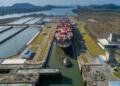
The canal’s operation is simple, but complex to operate. Upon reaching either end of the canal, ships must ascend 26 meters (m) above sea level using a system of locks that act as aquatic stairs. Once they reach this height, they simply navigate to the other end and repeat this action in reverse. Each transit discharges between 191,000 and 202,000 cubic meters of fresh water into the sea.
The cost of passing through the canal varies depending on the type, size, and cargo carried by vessels. The highest rates apply to Neopanamax vessels, with rates ranging from $400,000 to $800,000.
“We are actually a pretty expensive toll booth,” said Estela del Carmen Luck Archbold, Sustainability Manager for the Panama Canal, during her participation in the panel “ Success Stories in Sustainability and Decarbonization of Port Operations ” at the AAPA LATAM 2025 Congress .
Panama has owned the canal since 2000, when it was transferred to its administration by the United States government, its original builder. Until a few years ago, there were only three sets of locks, but in July 2016, two new Neopanamax locks were inaugurated , which feature basin systems for water reuse. These locks measure 427 m long, 55 m wide, and 18 m deep, allowing for the passage of larger ships.
Another major source of water supply for the canal is Lake Alhajuela, which, like Gatún, was built as a water reservoir and also operates one of the two hydroelectric plants managed by the Panama Canal Authority (ACP) . Both artificial lakes are responsible for leveling the depth of the channel .
However, the ravages of climate change around the world are affecting the operation of the Panama Canal. “Before, there was a severe drought every 18 or 20 years, then it was every eight, and now it’s every four… we have to prepare ourselves to survive and resist,” according to the canal’s sustainability manager.
To avoid future problems due to a lack of water to supply the canal, the government is planning to dammify the Indio River in the center of the country, a project that would take about four years and require an investment of $1.6 billion . This would allow for 12 to 13 more ship crossings per day and support the construction of water treatment plants, according to authorities.
“It’s been under study for at least 10 years… it should start next year. We have social issues to address. We’re asking for a pretty big sacrifice from people who own land that could become a lake in the future,” said Luck Archbold.
While the Panamanian government addresses the social issue, which includes around two thousand families that could be affected or relocated, international trade is closely monitoring what will happen to the canal to avoid future disruptions to supply chains.
Comment and follow us on X: @EnriqueDuRio / @GrupoT21