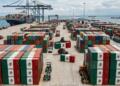
The Mexican Business Council for Foreign Trade, Investment and Technology (COMCE) Northeast Chapter warned that Mexico’s foreign trade will face three key challenges in the coming months: the reform of the Customs Law, U.S. tariffs, and the implementation of the Electronic Declaration of Value.
In this regard, the organization emphasized that the region will play a central role in defending the United States-Mexico-Canada Agreement (USMCA) heading into 2026.
“The USMCA defends itself by proposing. From the Northeast, we will bring evidence and solutions by industry. Our goal is clear: more certainty, workable rules, and smart customs for nearshoring ,” the agency stated in a statement.
Regarding the legislative initiative to reform the Customs Law , the Comce recognized the need to combat smuggling, but warned that the proposal ” expands the joint liability of customs agents without exclusions and adds causes for suspension or cancellation of patents .”
“We understand the objective: to close the door on smuggling. This year, the Tax Administration Service (SAT) opened 109 criminal cases for damages amounting to nearly 23 billion pesos and canceled dozens of patents. But the solution must balance control and competitiveness,” the agency stated.
In this regard, he called for the establishment of ” clear rules, proportionality, and due process , so that the flow of goods in Colombia, Nuevo Laredo, Reynosa, and Matamoros is not hindered. Strong customs, yes; bureaucratic customs, no.”
Regarding the 30% tariff announced by the United States, Comce noted that it did not go into effect on August 1st thanks to a 90-day extension, but warned that “the risk will reappear in November.”
The most exposed sectors are “ metals and some auto parts outside the rules of origin, as well as trucks, furniture, medical equipment and machinery .
“Our position is firm: neither a trade war nor naiveté. We will use consultations and, if necessary, the USMCA panel, while the industry secures rules of origin to maintain its preference,” he emphasized.
Furthermore, he recalled that the E2 format was published on August 1st in the Mexican Single Window for Foreign Trade (VUCEM) , making the Electronic Declaration of Value mandatory starting December 9th, 2025.
The agency explained that this measure will involve “a breakdown of prices, adjustments, royalties, assistance, Incoterms, supplier relationships, and support services .” Therefore, it recommended that companies “update contracts, document adjustments, and create a customs clearance form. Those who arrive prepared will ship faster and reduce the risk of tax credits.”
At a press conference, Comce insisted: “December 9th is NOT negotiable. Whoever arrives with complete dossiers will be able to process their case more quickly and with less risk. Our recommendation to our partners: no improvisations starting today.”
USMCA heading towards 2026
In preparation for the review of the agreement, the organization reported that the Ministry of Economy has opened consultations with approximately 30 sectors.
“The process will be more open than the traditional ‘Cuarto de Junto,'” he said.
From the northeast, Comce proposed including topics such as electromobility and batteries, certainty in the labor market, digital and artificial intelligence disciplines, semiconductors, and customs facilitation with real border interoperability on the agenda.
Comce Noreste closed its statement with a call for strategy and unity: ” Smart customs with professional customs agents using E-MAVAL, a negotiation and collection strategy for tariffs, and technical preparation for the USMCA . The Northeast is playing a serious role in ensuring that Mexico remains North America’s strategic partner.”
Comment and follow us on X: @GrupoT21