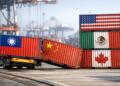
Following a call with her US counterpart, Donald Trump , Mexican President Claudia Sheinbaum confirmed the 90-day exemption from the 30% tariffs on Mexican products imported by the United States, which were to come into effect on August 1 and, among other effects, would have had a negative impact on Mexico’s logistics sector.
At her morning press conference this Thursday, the Mexican president said the 90 days would serve to achieve a better long-term agreement.
He asserted that the new extension is important because it safeguards the United States-Mexico-Canada Agreement (USMCA) , as everything covered by this agreement is tariff-free, although the tariffs on vehicles, as well as steel and aluminum, of 25% and 50%, respectively, remain in place.
He also emphasized that Mexico’s dialogue with the United States will continue. “We have the best possible agreement, compared to other nations,” he emphasized, noting that “we are staying the same, with nothing additional.”
In the call with Trump, Sheinbaum said she proposed to the White House resident some measures to reduce the United States’ trade deficit with Mexico, although she did not provide details.

For his part, Marcelo Ebrard, head of the Ministry of Economy (SE) , emphasized that the new agreement keeps Mexico in a better position than the rest of the world in terms of tariffs. “All of this was achieved without any other concessions on Mexico’s part, which will benefit the economy and bring us closer to renewing the USMCA,” he said.
He asserted that the 90-day extension underscores the “very special” agreement the United States has with Mexico, and said they will use this pause to reach a broader economic agreement.
Tariff extension, a relief for logistics
Carlos Martner , coordinator of Integrated Transportation and Logistics at the Mexican Institute of Transportation (IMT) , considered that if the 30% tariffs had gone into effect, there would probably be a rearrangement in the supply chains , as exports would decrease as a result of the imposition of this rate.
In an interview with T21, he explained that said tax would only apply to exports that are outside the T-MEC and “according to data handled by the Business Coordinating Council (CCE)They estimate that approximately 84% of exports to the United States are tariff-free and are part of the trade agreement.
He pointed out that if the data is correct, the impact would have been approximately the remaining 16%, which would have increased the costs of products outside the trilateral trade agreement.
“What would be expected is for exports to decrease within that percentage in the short term, because although these are necessary products in the United States, due to their cost, the tendency is to reduce exports because they will also have an impact on American consumers,” he said in an interview.
The IMT specialist considered that cross-border land transport would have been the segment most affected by the 30% tariffs, “and perhaps, to some extent, the railway sector.”
“The trucking sector would be affected because there would be fewer exports, fewer export movements, and, to some extent, probably the railroad sector,” he explained.
In March 2025 alone, border crossings reached one of their highest levels. According to data from the Bureau of Transportation Statistics (BTS) , total cross-border cargo between the United States and its North American partners reached a value of $144.8 billion , an increase of 8.4% compared to the same month the previous year.
During the reference period, trade between Mexico and the United States totaled $55.6 billion, reflecting the importance of the logistics and transportation sector between the two countries. This pause therefore provides a respite for both industries.
Regarding intermodal transportation , Martner believes there would be minimal impacts “because the supply chains there are very defined and there is basically a predominance of the automotive industry, which we understand is mostly within the USMCA, and some other sectors that send products there, which are also normally important within the trade agreement.”
Comment and follow us on X: @Eliseosfield / @GrupoT21