In a market experiencing a slowdown, with pressured tariffs and erratic demand, Mediterranean Shipping Company (MSC) has reached a milestone that confirms its dominance in global maritime transport: surpassing the seven million twenty-foot equivalent unit (TEU) fleet capacity mark , according to a report by Alphaliner . The Swiss-Italian shipping company is not only consolidating its position as the world’s largest container carrier, but also redefining the scale of competitiveness in an industry characterized by oversupply and fragmented alliances.
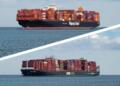
The achievement was solidified with the almost simultaneous delivery of two 16,000 TEU Neo-Panamax vessels: the MSC Salerno, built by Dalian Shipbuilding Industry Company (DSIC), and the MSC Grace, from the Yangzijiang Shipyard (YZJ). With these additions, MSC became the first container shipping line to reach a total capacity of seven million twenty-foot equivalent units (TEUs), a figure that illustrates the breakneck pace of its expansion. It took only 15 months to go from six to seven million TEUs, a growth rate that few players in the recent history of the sector have managed to sustain in such a short time.
The driving force behind this expansion came not from corporate acquisitions or operational alliances, but from organic growth through new construction. During this period, the company added 68 new vessels, equivalent to an additional 799,000 TEUs. This figure reflects the magnitude of its vertical integration strategy: while other shipping companies are slowing their orders due to falling freight rates and geopolitical tensions, MSC continues to invest in a more modern, diverse, and energy-efficient fleet, aiming to dominate the main interoceanic routes.
A revealing indicator of MSC’s new growth profile is the composition of its recent fleet. According to Alphaliner, since surpassing the six million TEU mark, it has not acquired any “Megamax” class vessels, the giants exceeding 23,000 TEU. Instead, its focus has been on the so-called “NPX” vessels—Neo-Panamax ships of 14,000 and 16,000 TEU—of which it has added 33 units. This decision is not accidental: it stems from an operational strategy that prioritizes flexibility and efficiency on routes that do not depend on the Suez Canal or ports with draft limitations. In this sense, diversification gives MSC a tactical capacity to adapt to scenarios of congestion, closures, or diversions, such as those that have characterized post-pandemic maritime trade.
Another area of expansion has been the chartering market. In the last fifteen months, the company has signed more than 50 vessel charter agreements, although approximately half of these are extensions of previous agreements, making them capacity-neutral. However, some 25 new vessels—equivalent to 135,000 TEU—have been added through fresh charter contracts , reinforcing secondary routes and regional services where MSC has found sustainable profit margins. This move demonstrates the company’s ability to combine ownership and leasing with a market-driven approach that seeks to capitalize on low tonnage availability without compromising its financial flexibility.
The other source of growth comes from the second-hand market. During the same period, MSC and its affiliated entities acquired more than 250,000 TEUs of used vessels. Although many of these were already operating under charter agreements, the decision to purchase them consolidates operational control and eliminates dependence on third parties during volatile periods. This strategy aligns with its long-term vision: acquiring strategic assets when the market cycle favors low prices, thereby maintaining a homogeneous and controllable fleet, ready to reposition itself in response to changes in demand or environmental regulations.
MSC’s meteoric growth is not only symbolic—being the first shipping company to break the seven million TEU barrier—but also introduces structural tension into the global market. Its expansion rate is double that of its immediate competitors and increases the pressure on alliances such as Gemini Cooperation, Ocean Alliance, and Premier Alliance , which face a forced reconfiguration due to the fragmentation of interests and the end of major cooperative agreements. By expanding its capacity organically, MSC positions itself to negotiate from a position of strength, control larger service quotas, and potentially redefine the tariff structure on key routes.
However, this growth also raises critical questions about sustainability and market equilibrium. In a context where global demand for maritime transport is growing slowly and inventories are adjusting due to nearshoring , such aggressive expansion could exacerbate the overcapacity already putting pressure on rates. MSC seems aware of this, but its strategy suggests a long-term approach: consolidating its fleet while construction costs are competitive, renewing vessels to cleaner standards, and preparing the ground for a future market reorganization.
MSC’s achievement encapsulates a decade of strategic accumulation: organic growth, sustained investment, asset control, and a keen understanding of maritime cycles. But it also reflects an ambitious vision that doesn’t settle for simply dominating the present, but seeks to shape the rules of the future. In a sector where scale defines survival, MSC is not just expanding its fleet: it’s expanding its power to influence routes, prices, and ultimately, the very pace of global trade.
Comment and follow us on X: @GrupoT21