The First State of the Union address of Mexican President Claudia Sheinbaum Pardo left more questions than answers about the direction of port policy. While the administration boasts an investment of 5.4499 billion pesos in 40 maritime infrastructure projects at 11 ports across the country, the document lacks details on the progress and goals at key ports such as Manzanillo and Lázaro Cárdenas , which handle more than half of the containerized cargo entering and leaving Mexico.
The contrast is evident: the Report devotes space to describing the modernization of Salina Cruz —part of the Isthmus of Tehuantepec Interoceanic Corridor (CIIT) project and inherited from the previous administration—with technical data on the construction of a breakwater, supposedly “the largest in Latin America (1,600 meters long),” as well as dredging to increase the depth to 24 meters and the base width to 133 meters, thereby “expanding its capacity to accommodate 250,000-ton container ships and handle up to 1.4 million containers annually”; as well as plans for a container terminal with road and rail connectivity.
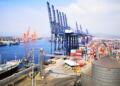
However, regarding Manzanillo and Lázaro Cárdenas, it merely includes them on a list of ports undergoing modernization, without specifying works, timelines, or additional capacity. In a context where both ports suffer from overcrowding and bottlenecks, this omission is not minor .
Old problems
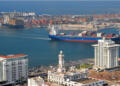
T21 has reported that Manzanillo has been facing a critical scenario since mid-2025: a collapsed customs office, delays in dispatch appointments, and a labor blockade that worsened congestion in mid-May. Transporters have seen their productivity plummet, with lost trips due to long lines, and cost overruns that are passed on to the entire logistics chain . The country’s most important port, through which most of the goods from Asia enter, is operating at the limit of its capacity, with no immediate solutions from the federal government.
The report does not even mention the Cuyutlán or Nuevo Manzanillo port project , which is intended to address the port’s problems in the near future.
Lázaro Cárdenas, meanwhile, appears in the Report as a port “undergoing modernization,” but the reality is more complex. Customs inspections have been tightened with new X-ray equipment and a greater military presence, which strengthens security but also lengthens processing times and strains operational efficiency .
The gap between official rhetoric and the facts on the ground raises a major underlying question: Is it sufficient to list global investment amounts without detailing strategic projects in the most pressured ports?
The Sheinbaum administration appears to be repeating a pattern from previous reports: announcing investment figures and talking about modernization, without providing transparency on timelines or the additional capacity generated . Meanwhile, cargo continues to accumulate, carriers absorb cost overruns, and importers face uncertainty in logistics flows.
The underlying challenge is to prevent the investment narrative from obscuring the lack of immediate solutions for a port system that is currently teetering on the brink of collapse .
Comment and follow us on X: @EnriqueDuRio / @GrupoT21