SAN MIGUEL DE ALLENDE, GTO.- “Manzanillo has problems, but we are working on them .” With that phrase, José Antonio Contreras, president of the Manzanillo Terminals and Operators Association (ASTOM) , set the tone at the start of the ASTOM Summit 2025, held in this colorful colonial city. The forum, in its second annual edition, has brought together the business community linked to international trade that operates in the most dynamic port on the Mexican Pacific, with a special emphasis on imports from Asia.
Contreras didn’t shy away from reality. He acknowledged that the port has faced bottlenecks stemming from its own success: “Manzanillo has experienced extreme success in terms of volume, which has brought us challenges and problems.”
However, he emphasized that terminals and port operators continue to invest in infrastructure and equipment , and that the key has been coordinated work with authorities to overcome crises such as the recent customs emergency.
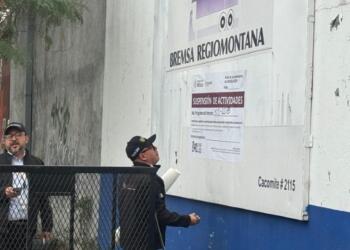
Last May, Manzanillo customs workers themselves blocked and closed the port entrances for several days, an internal protest that resulted in a significant operational paralysis. The impact was severe. More than 70 foreign trade officials abandoned their posts, which diminished the customs’ operational capacity and, consequently, stranded merchandise in an unprecedented situation, causing, above all, serious financial problems for the companies that use the port.
A narrative of leadership
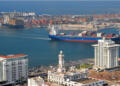
The institutional video shown during the ASTOM meeting reinforced this narrative of resilience and leadership. With an aspirational tone, he emphasized that Manzanillo is Mexico’s number one port, consolidated over decades as the country’s main logistics hub. He highlighted its strategic location, its more than 400 hectares of surface area, its 20 berths, and its capacity to receive mega-ships up to 400 meters in length .
The audiovisual piece highlighted that more than 40% of the containers entering and leaving Mexico transit through its terminals and that it accounts for 70% of the imports arriving on the Pacific coast . It also showed that the port has more than 30 entry and exit gates and five kilometers of railway that connect it directly to the country’s industrial and consumer clusters.
The message also highlighted private investment: the business groups that make up ASTOM have allocated more than 35 billion pesos to provide Manzanillo with modern infrastructure, which currently includes 28 gantry cranes, 12 mobile cranes, 108 RTGs, 344 tractor-trailers, and more than 340 forklifts. Added to this is the human factor: a team with more than 35,000 direct and indirect jobs, operating 24/7 to ensure the continuity of the logistics chain.
The economic dimension was clear: Manzanillo is the port that contributes the most to the country in compensation, taxes, and customs revenue. Hence the emphasis on its growth as not just a local issue, but a key element that sustains national competitiveness. “We have an obligation to continue growing and improving ,” the official voice heard in the video.
Highway infrastructure: Colima’s vision
The governor of Colima, Indira Vizcaíno , present at the ASTOM event, brought the discussion to a key area: land connectivity, which has long been one of the weakest links in the operation of the port of Manzanillo and its surrounding areas . “We have called this entire series of investments in road infrastructure, totaling more than 20 billion pesos, a logistics corridor,” she explained.
The public and private projects include the expansion of the Tepalcates Bridge from two to six lanes, the modernization of the Armería-Manzanillo highway, a toll bypass that will reduce bottlenecks, and a new route for the dangerous stretch known as La Salada. He also highlighted the construction of the southern bypass to transport cargo away from the urban center of Manzanillo. “This will allow us to significantly streamline traffic and the container entry and exit process ,” he emphasized.
Vizcaíno contextualized these investments within a larger project: the expansion of the port to basin II of the Cuyutlán Lagoon, already announced as a six-year commitment. With this, port capacity could double or even triple. “What gives me satisfaction is seeing that the current vision is not only about solving problems, but also anticipating what will be needed when the expansion is completed,” he stated.
The USMCA on the port’s agenda
The backdrop for this discussion is international trade . José Antonio Contreras had already warned: “The market is moving in directions that none of us can determine… tariffs, yes, tariffs, tariffs on China? How will this affect us in Manzanillo?”
Trade uncertainty was a key factor in the discussions at the ASTOM Summit 2025, particularly in light of the upcoming revision of the United States-Mexico-Canada Agreement (USMCA) .
José Ignacio Aguado, Director General of Innovation, Services, and Domestic Trade at the Ministry of Economy , explained that the renegotiation cannot be improvised: “We don’t want to make unilateral decisions from behind a desk. You will be invited to participate in these decisions.”
He emphasized that on September 30, consultation tables will be set up with business leaders from the logistics sector , specifically to identify “what is hurting them, what we need, and what we should bring to the review table.”
The official recalled that Mexico has designed Plan Mexico , led by President Claudia Sheinbaum, whose operational arm is the economic corridors of well-being and development hubs . Logistics, he said, is the cross-cutting axis: “There is no economic activity that does not depend on logistics.” In that sense, Manzanillo is not just a port: it’s a barometer of how the country will face changes in trade rules with North America.
Indira Vizcaíno agreed that dialogue with the United States and Canada will be crucial. “The process of entering into the renegotiation of the USMCA must have many of us in a state of uncertainty, but I believe there is specific data that tells us that positive progress has been made,” she stated.
For Colima, the stability of this trade framework is crucial: a large portion of the cargo entering through Manzanillo ends up in manufacturing clusters that export to North America.
A narrative of continuity
The ASTOM Summit 2025 seeks to demonstrate that Manzanillo, despite congestion and geopolitical tensions, maintains a leading role. Contreras insisted that the 74% growth in imports from 2020 to date is unparalleled in the Latin American Pacific . Vizcaíno outlined how highways seek to support port expansion and mitigate externalities. Aguado, from the federation, placed logistics as the backbone of industrial policy and the future of the USMCA.
Beyond the numbers, the narrative of the meeting is driven by the idea of anticipating things. “What’s important is what lies ahead,” Contreras summarized. With the port operating at full capacity and an expansion underway, the real challenge will be to articulate investments, roads, trade agreements, and sustainability into a single equation that will allow Manzanillo to continue being Mexico’s gateway to the world.
Comment and follow us on X: @EnriqueDuRio / Sent / @GrupoT21