Even in a global environment marked by logistical challenges, geopolitical disruptions, and a slow-growth international economy, the Danish giant AP Moller-Maersk once again demonstrated its ability to navigate uncertain waters with precision. The company reported solid financial results for the third quarter of 2025 (3Q25), driven by operational efficiencies, cost control, and a sequential rebound across all its business lines. While revenue was lower than the same period of the previous year, the performance confirms that the group has consolidated a resilient structure in the face of the global maritime trade slowdown.
Quarterly revenues reached $14.2 billion, down from $15.8 billion in the same period of 2014, but with a visible improvement in profitability: EBITDA was $2.7 billion and EBIT was $1.3 billion, compared to $4.8 billion and $3.3 billion, respectively, in the previous year. This reduction is due to a natural market adjustment after years of oversupply and the post-pandemic normalization of rates. However, the strategic interpretation is different: Maersk has managed to maintain positive margins and financial discipline in a downturn, an achievement few global logistics operators can boast.
Vincent Clerc, CEO of Maersk, attributed this result to the company’s “ability to execute and continuous improvement,” as well as the sustained trust of its customers. “The new east-west network has strengthened our Ocean Freight segment, offering industry-leading reliability, higher volumes, and lower costs,” he noted. His words summarize the group’s structural strategy: to transform a historically shipping company into a comprehensive logistics operator, capable of offering end-to-end solutions and mitigating the cyclical fluctuations of maritime transport.
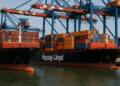
The Ocean Freight segment , the company’s traditional core business, registered a 7% year-on-year increase in cargo volumes, supported by the Gemini cooperation, an alliance with Hapag-Lloyd established this year, which enabled substantial cost savings and greater network efficiency. Freight rates remained stable compared to the previous quarter, in a context where competition and global overcapacity are putting downward pressure on prices. Ocean EBIT reached $567 million, more than double the previous quarter ($229 million), although still far from the $2.8 billion reported a year earlier, when profitability reached exceptionally high levels.
In Logistics and Services , growth was driven by sustained operational improvement and the advancement of its Fulfilled by Maersk platform, particularly in warehousing solutions. The operating margin rose to 5.5%, from 4.8% in the previous quarter, with EBIT of US$218 million, surpassing the US$175 million of the previous quarter and the US$200 million projected for the same period in 2024. This performance confirms the maturation of Maersk’s logistics business , which aims to decouple its profitability from the fluctuations of ocean freight and consolidate its position as a key player in supply chain management.
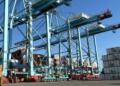
Meanwhile, the Terminals segment broke records once again: volumes grew 8.7%, driven by demand in the Americas, Europe, and Africa, and by an average utilization rate of 89%, with some ports operating near full capacity. EBIT reached $571 million, compared to $461 million in the previous quarter and $338 million in 2024. This trend reaffirms that ports, more than just physical links, are the operational core of the logistics integration that Maersk seeks to expand, integrating its maritime network with land-based, intermodal, and value-added services.
The group also reported a $578 million cash distribution to its shareholders, derived exclusively from share buybacks, a sign of confidence in its strength and future cash flow generation. This balance between financial return and strategic reinvestment has been a constant under current management.
Maersk raised its 2025 financial guidance, increasing the lower end of its projected range, and revised its global container market growth estimate to around 4%, up from the previous range of 2% to 4%. However, the company acknowledged that disruption in the Red Sea will continue to affect shipping routes throughout the year , a reminder that geopolitical challenges continue to shape global logistics.
The group’s operational strength is also measured by its long-term vision. Maersk remains committed to achieving net-zero greenhouse gas emissions by 2040 through investments in vessels powered by low-emission fuels and new propulsion technologies. This objective, which goes beyond regulatory compliance, aims to reshape the logistics business model based on sustainability, resilience, and energy efficiency.
Unlike previous years, when results were driven by historically high rates, the most recent quarter reflects a different kind of strength: that of a company that has learned to operate efficiently under normal circumstances. In an environment where margins are shrinking, fuel costs are rising, and routes are strained by regional conflicts, Maersk appears to have found a balance between growth, profitability, and structural transformation. The challenge now will be to sustain that stability when the market turns again.
Comment and follow us on X: @GrupoT21