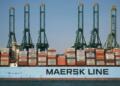
Logistics company Maersk marked a new milestone in its decarbonization strategy with the naming of the Berlin Mærsk , the first vessel in a new series with a capacity of 17,480 20-foot containers (TEU) and dual methanol propulsion. The naming took place at a ceremony at the Hyundai Heavy Industries (HHI) shipyard in Ulsan, South Korea.
The Berlin Mærsk is the fourteenth such vessel in the Maersk fleet and is part of a new class of high-capacity container ships. Five sister vessels will follow in 2025.
“With the launch of the Berlin Mærsk class, we continue to build a maritime portfolio adaptable to multiple fuel alternatives. Fleet renewal is essential to maintaining our competitive advantage in maritime transport and is a cornerstone of our commitment to decarbonization,” said Anda Cristescu, Head of Chartering and Newbuildings at Maersk.
With its scheduled arrival at the port of Shanghai on July 7, the Berlin Mærskwill begin operations on the AE3 route, which connects East Asia with Northern Europe.
The design of the Berlin Mærsk is very similar to that of the previous Ane Mærsk class , of which Maersk has taken delivery of a total of 12 dual-fuel vessels, all built by HHI. The only difference between the two vessels is the wider beam, which allows the Berlin Mærsk to carry more containers.
The six vessels in the series, currently under construction by HHI, will be ready by 2025 and will operate under the Danish flag.
In 2024, container shipping reached an all-time high in carbon dioxide (CO₂) emissions. According to data from Xeneta and Marine Benchmark , global emissions increased by 14% compared to 2023, totaling 240.6 million tonnes of CO₂. Vessels with capacities between 14,500 and 20,000 TEU were the main emitters, with 24.2 million tonnes recorded.
Comment and follow us on X: @GrupoT21