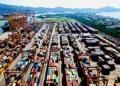
Minutes have stretched into hours on the Colima-Manzanillo highway . Traffic moves in fits and starts, then grinds to a halt, and drivers watch the line lengthen, uncertain of how long it will take to reach the port. Construction on the La Salada section has created a bottleneck that completely disrupts arrival times.
For trucking companies, delays mean more than just fatigue: they represent lost work and days that can’t be recovered. Yax Tzel Nolasco Gómez, president of the Manzanillo Freight Carriers Union (UTCM) , explained : “If you don’t arrive on time, they won’t take you. Even if you left early, if traffic is at a standstill, you’re not going to make it.” Uncertainty dominates every trip. “Sometimes it takes an hour, sometimes it takes three. When they’re doing roadwork, it creates a bottleneck.”
The direct consequence is the loss of paid service. “The operator left on time, but if they don’t come in, the client says they won’t pay. And that’s not how things work,” warned Nolasco Gómez. In Manzanillo, where every minute counts, delays become a financial blow. “You don’t know if you’re going to do two service calls or none at all. It’s a daily problem.”
In an interview with T21, he recalled that the backlog is not recent; he explained that the port’s growth has been constant, but the highway infrastructure has not kept pace. He pointed out that the Colima-Manzanillo highway has been operating under virtually the same conditions for decades, despite the increased cargo volume. In his words, “the highway is over 30 years old and it has never been finished properly,” which is now reflected in bottlenecks that can no longer handle the current traffic.
The logistical impact is even greater considering the size of the port. According to official figures from the Mexican Navy , the Port of Manzanillo registered a total of 111,602 truck entries in July 2025 , representing an average of 3,600 units per day .

From January to October 2025 , cumulative revenue reached 1,009,604 trucks , a 3% increase compared to the previous year. In a system of this scale, any disruption to the single access road ultimately affects the punctuality of appointments and the operation of thousands of containers.

Official data shows that the port operates with very high traffic volumes. In 2024, there were 32 days with peak truck traffic, and between January and October 2025 alone, there have already been 25 days with over 4,500 trucks . February 20, 2025, saw one of the highest peaks, with 4,626 trucks . These figures confirm that the pressure on access roads is constant.

The highway works are necessary, but while they progress, the pressure falls directly on the operators. Each closed or reduced section causes additional delays that aren’t reflected in the port’s appointment systems, but are reflected in the carriers’ bottom line. The road, which should be an efficient corridor, is currently operating at its maximum capacity during peak hours.
For truckers, the problem is neither new nor sporadic. Delays have become a daily occurrence, and the lack of alternative routes forces all trucks to pass through the same critical point. Operations become strained, maneuvers uncertain, and the logistics chain of the Pacific’s most important port is ultimately subject to the pace of a construction project that progresses in stages.
(Main image source UTCM)
Comment and follow us on X: @karinaquintero / @GrupoT21