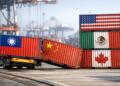
Despite rising geopolitical tensions and signs of a global economic slowdown, global trade grew in the first six months of 2025, expanding by approximately $300 billion , according to the latest World Trade Update published by the United Nations Conference on Trade and Development (UNCTAD) .
According to the report, global trade increased by nearly 1.5% in the first quarter of the year, with projections pointing to a 2% increase for the second quarter.
 Services trade registered the largest increase, with 9% over the last four quarters, driven by a slight rise in goods prices, which boosted the value of trade, although trade volume grew only 1%.
Developed economies , the report noted, regained trade leadership in the first quarter of 2025, driven by a 14% increase in imports from the United States and a 6% increase in exports from the European Union.
In contrast, developing countries saw a 2% drop in imports, except for Africa, which saw 5% growth in exports and 16% year-on-year growth in intraregional trade.
Despite the positive signs, trade imbalances intensified . There was a larger deficit in the United States and growing surpluses in China and the European Union. Bilateral gaps also widened between the United States and its main partners, such as China, whose annual deficit was $360 billion, while with the European Union it was $276 billion, and with Vietnam, $116 billion.
 Global trade challenges for the rest of 2025

The report noted that global trade will face increasing challenges in the second half of 2025 , amid persistent political uncertainty, geopolitical tensions, and signs of slowing global growth.
In this regard, he explained that new US tariffs, such as the base rates of 10% and 25% on steel and aluminum, have increased the risk of trade fragmentation . Although retaliation has been limited, the threat of an escalation of unilateral actions that could spread to other countries and destabilize supply chains persists.
The report also indicated that a strengthening of isolationist industrial policies is expected , especially in strategic and high-tech sectors, which could disrupt deeply integrated global production networks.
However, there are still signs of trade strength. Freight indices have recovered from their lows , regional integration is strengthening, and trade in services continues to grow.
According to UNCTAD, the key to sustaining this resilience will be “policy clarity, geoeconomic developments, and supply chain adaptability . ”
Comment and follow us on X: @GrupoT21