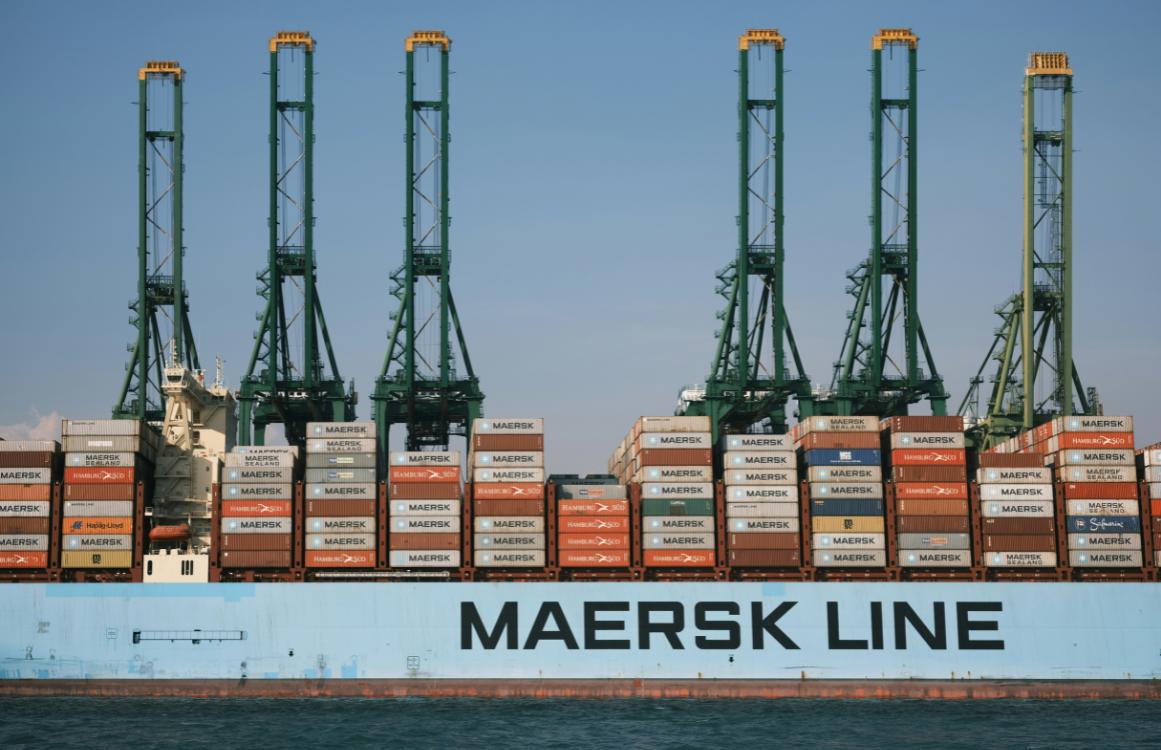
AP Moller-Maersk reported on Monday that it has taken a significant step in reconfiguring its global maritime network by ordering eight large 18,600 twenty-foot equivalent unit (TEU) vessels from New Times Shipbuilding in China, under a homogeneous design that will be part of a series planned for deliveries between 2029 and 2030.
The decision to opt for vessels measuring 366 meters in length and 58.6 meters in beam, somewhat more compact than the ultra-large ships that now dominate shipbuilding, stems from a logic of operational and strategic flexibility . It prioritizes modular capabilities that can be integrated into both main routes and secondary services within the company’s extensive logistics network. This commitment is part of an ongoing fleet renewal that, according to the shipping company, sustains its competitiveness in a context of volatile demand and evolving supply chains.
Choosing a configuration that allows for deployment flexibility underscores a broader phenomenon in shipping: the growing need to adapt capacity to markets where cargo volumes and geopolitical conditions are rapidly changing . Large, but not excessively large, vessels facilitate efficient connections on major east-west routes without sacrificing capacity for regional services or ports with infrastructure limitations, thus offering ample options for adjusting itineraries and deployments to meet fluctuating trade patterns.
In terms of technology and sustainability, the new vessels will be equipped with dual-fuel engines, capable of switching between conventional bunker fuel and liquefied natural gas. This feature responds to increasing regulatory and market pressure to reduce emissions and move towards cleaner fuels, while simultaneously maintaining operational options in the face of an alternative fuel bunkering infrastructure that is still expanding.
Financial strength
The investment and fleet expansion decision comes at a key financial moment for Maersk. During 2025, the company recorded solid performance across its various business units , driven by volume growth, refined operational execution, and proactive cost control measures that enabled results to reach the upper limit of its annual financial guidance.
Last week, Maersk reported annual revenues of $54 billion , as well as an EBITDA of $9.5 billion and an EBIT of $3.5 billion. These figures, while reflecting some pressure on margins compared to extraordinary levels in 2024, demonstrate a solid capacity for value creation, especially considering the challenges of the freight market and the overdemand for capacity in the global maritime sector.
The diversification of results within the group was also evident: the Terminals segment achieved its best historical figures, driven by record volumes, improved rates, and higher revenues from ancillary services, consolidating its role as an anchor of profitability within the organization. Logistics and Services progressed in its operational regrouping towards more specialized sub-segments, while the maritime business confirmed volume growth of close to 4.9%, in line with the global market, although with a decline in rates due to excess capacity in the global fleet.
This 2025 outlook provides the financial and strategic framework that explains the company’s strong commitment to new fleet assets: Maersk is not only consolidating its position as a dominant player in container shipping, but is also leveraging its financial strength to plan for the long term. The order book now includes 33 vessels, with four deliveries scheduled for the remainder of 2026 , reflecting a deliberate focus on managing the pace of asset acquisition so that fleet modernization aligns with market developments and customer needs.
Taken together, the order for the new vessels and the 2025 operating result point to a Maersk that seeks to align its physical infrastructure with an integrated logistics vision , where investment decisions are measured not only in terms of transport capacity, but also network flexibility, energy efficiency and resilience to the dynamics of international trade.
Comment and follow us on LinkedIn: @GrupoT21