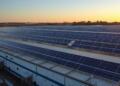
In a context where pressure to decarbonize industrial operations is increasing, distributed generation is emerging as a strategic solution for industrial parks and manufacturing centers in Mexico.
This is key for the Mexican industry, where nearshoring (relocation of production lines) is driving new manufacturing facilities, explained Manuel Ahumada, managing partner of Enlight , a company specializing in microgrids and energy storage.
“Distributed generation is generating energy right where it’s consumed,” Ahumada explained.
He added that, unlike large solar or wind farms connected to the national grid, this model takes advantage of vacant spaces such as industrial warehouse roofs to install solar photovoltaic systems that directly power the plants’ operations.
One of the key differentiators of Enlight’s model is that companies don’t need to invest in infrastructure.
“We make the investment, and the customer only pays for the energy generated,” Ahumada said.
This has been key to facilitating the adoption of clean energy solutions, especially among companies with high energy demands, such as those in the automotive, food, and logistics sectors.
In addition to solar panels, Enlight has integrated lithium-ion battery storage , enabling the formation of smart microgrids .
These systems not only generate energy during the day, but also store electricity during lower-cost times for use during peak periods, thus generating greater savings.
“A microgrid can represent up to 90% energy cost savings for our customers,” Ahumada said.
Furthermore, it allows operations to continue even in the event of power outages, which has become increasingly important given the recent disruptions to the national power grid.
According to the executive, the arrival of the new government has brought encouraging signs for the sector.
Currently, the limit for distributed generation is 500 kilowatts peak (kWp) per site, but the new administration’s energy plan contemplates raising this to 700 kWp and even enabling self-consumption schemes for projects of up to 20 megawatts, under an express modality.
“We’ve been experiencing a stagnant regulatory environment for six years. Today, we’re seeing clear signs of momentum, which is very motivating for us,” he said.
The sector’s growth has been steady: interconnection requests have increased by 25 to 30% annually, and in Enlight’s case, its own projects have grown by more than 40% year-over-year.
This boom is fueled by trends such as nearshoring , which has brought new factories to Mexico with high energy demands and a growing interest in sustainable solutions.
“Any company with a demand greater than one megawatt is a candidate,” Ahumada said.
This ranges from hotel groups to distribution centers, industrial parks, and manufacturing plants, even in vertical installations with limited roof space, the combination of panels and batteries makes the model viable.
Ahumada emphasized that the benefits are not only economic .
“We’re talking about hundreds of thousands of liters of water saved and a significant reduction in carbon dioxide (CO2) emissions,” he stressed.
Additionally, companies can access clean energy certificates (IRECs), allowing them to strengthen their ESG (environmental, social, and governance) strategies and, in some cases, monetize these benefits in voluntary carbon markets.
Comment and follow us on X: @jenna_GH_ / @GrupoT21