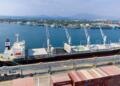
The Ministry of the Navy (Semar) is willing to launch the Nuevo Manzanillo (Cuyutlán Port) project before the end of Mexican President Claudia Sheinbaum’s term. And no proposals have been spared.
At the last extraordinary session of the Board of Directors of the National Port System Administration (Asipona) Manzanillo , held on June 20, it was reported that the port authority plans to begin the administrative process for the relocation of the Specialized Container Terminal (TEC) I , concessioned since 1995 to the American company SSA Marine Mexico , to the port of Cuyutlán.
“(…) this ASIPONA Manzanillo considers the relocation of TEC I feasible for reasons of public interest,” according to a document signed by Asipona Manzanillo presented at the Board of Directors meeting, of which T21 has a copy.
In November 2024, the federal government launched the priority project for the construction of the “Puerto Nuevo Manzanillo Cuyutlán” (New Port of Manzanillo Cuyutlán)—a total of 1,880 hectares— which plans to include up to four specialized container terminals , the current largest business line of the Port of Manzanillo. This measure seeks to address the operational problems facing the main commercial port on the Mexican Pacific due to the saturation of its current terminals.
Since the Executive’s announcement, the local and international port community has been waiting for Asipona Manzanillo, a subsidiary of Semar, to publish the bidding rules for the first two terminals considered for the project’s initial phase.
According to the Asipona Manzanillo document, the main legal basis for proposing the relocation of TEC I is referred to in what is explained in the penultimate paragraph of article 41 of the Ports Law: “The Secretariat, with a view to the public interest, may modify the uses, destinations and modes of operation provided for in the PMDP (Port Development Master Plan) with respect to the different areas of the port or group of them or terminals not yet used.”
However, to carry out the relocation, Asipona Manzanillo requires SSA Marine Mexico to make a minimum investment of 800 million dollars (mdd) applicable to preliminary studies and the construction work carried out by the American company in the development of the transition project to the port of Laguna de Cuyutlán, where it would go from the current 35 hectares to almost 90 hectares, similar to those of TEC II, operated by Contecon Manzanillo .
With this relocation, the port authority expects to alleviate Manzanillo’s ongoing congestion problems and allow it to reorganize the port with the 1,500 meters of dock and 35 hectares of storage space that SSA Marine Mexico would make available at TEC I of the Port of San Pedrito (current Port of Manzanillo).
TEC I is the main container terminal in the port of Colima. Last year alone, it handled a total of 1,724,906 TEUs , representing 43.9% of the total TEUs handled in the port, according to statistics from the General Coordination of Ports and Merchant Marine (CGPMM) , an office of the Ministry of Marine Affairs (SEMARNAT).
The document highlights that over the past 10 years, volumes recorded at the Port of Manzanillo have been steadily increasing, with no opportunity to expand the port’s infrastructure to meet the demand for services , which has posed a challenge for maintaining operational efficiency.
In the last decade, the handling of cargo increased from 25.2 million tons in 2015 to 31.4 million tons in 2024, particularly in the case of containers, which increased from 18.1 million tons of containerized cargo to 23.58 million tons, which in container boxes represents increasing from 2.54 million 20-foot containers (TEU) in 2015 to 3.9 million TEU last year.
The document, held by T21, highlights the following advantages of relocating SSA’s TEC I to the Laguna de Cuyutlán port:
- Streamline port operations and maintain the efficiency and functionality of port operations and facilities at the Port of San Pedrito (subordinated to the Port of Manzanillo).
- Immediate development and operation of the Laguna de Cuyutlán port, so that from its inception and as soon as possible, it will have the infrastructure of a competitive port terminal that efficiently meets the demand for port services.
- Under the assumptions of the agreement, and the timeframes analyzed for accelerated planning and development, the new TEC I will be established and operational in the fourth quarter of 2029 in Laguna de Cuyutlán.
- Ensure an orderly and rapid transition to the port of Laguna de Cuyutlán, maintaining the competitiveness of its operations and their costs, which impact the price and availability of imported or exported goods for the consumer or producer population.
- Dimension and equip the new terminal with automated technology and systems to optimize operational efficiency, minimize response times, improve cargo handling capacity, ensure safety, and reduce CO2 emissions by prioritizing rail transport and reducing the margin for road transport.
- Achieve the new TEC I to handle at least 2.5 million TEUs by 2037.
- Maintain the continuity of operations throughout the Manzanillo-San Pedrito-Laguna de Cuyutlán port system.
- Maintaining the growth of the container business line , allowing for the funding of the development of inland navigation facilities, which has naturally been determined as the vocation of the Manzanillo system to go from handling 3.9 million TEUs annually to more than 10 million.
- Generate 4,731 new jobs with the relocation of TEC I, both in its construction and with the reorganization of the southeastern San Pedrito area.
- Inject an estimated investment of US$800 million into the port of Laguna de Cuyutlán for construction works that will benefit Asipona.
- Seek financing mechanisms to provide infrastructure and service delivery for the hectares that TEC I will use at the new location.
- Obtain a substantial increase in the amounts of the fixed and variable consideration from TEC I, as a result of the increase in the surface area subject to the transfer at the new location in the port of Cuyutlán and the growth in the number of containers that TEC I will move at the new location.
Likewise, the document also indicates that Asipona Manzanillo will propose to the owner of TEC I that he initiate the necessary steps, studies, and actions to carry out the relocation of its specialized terminal under the following requirements:
- Carry out the relevant procedures in coordination with this Asipona Manzanillo and with the authorization of the competent port authority to ensure an orderly, coordinated, and expeditious transition to the port of Laguna de Cuyutlán.
- Make a minimum committed investment of US$800 million for preliminary studies and construction work carried out by SSA Marine for the development of the transition project to the port of Laguna de Cuyutlán.
- Maintain payments of the corresponding considerations for the areas currently operated, in accordance with the transition schedule and in adherence to the currently established amounts and their corresponding updates, maintaining the level playing field established by Asipona Manzanillo between container terminals.
- Begin payments of the corresponding consideration for the areas to be built and operated , in accordance with the transition schedule and in adherence to the currently established amounts and their corresponding updates, maintaining the level playing field established by Asipona Manzanillo between container terminals.
- Determine, through financial analysis, the necessary timeframe to cover infrastructure investment costs , consideration payments, operating expenses, and expected profitability.
The Asipona Manzanillo document does not clarify whether other terminals could be invited to participate in the same relocation process to the port of Cuyutlán, as Contecon Manzanillo, or whether a future bidding process will continue to be considered for the other three terminals considered in the federal government’s project.
Cuyutlán Lagoon has an area of water and land four times larger than the current port area , which is expected to meet the constant growth in demand for the movement of goods, mainly imports, which on several occasions has exceeded the supply of private infrastructure and logistics services.
Comment and follow us on X:@EnriqueDuRio / @GrupoT21