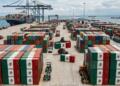
For Panama, the Isthmus of Tehuantepec Interoceanic Corridor (CIIT) and the Panama Canal are complementary, with different functions and capabilities, so authorities are working to develop a common vision on these issues.
“They are complementary industries. The business model and technical basis for the Panama Canal are different from how the Interoceanic Corridor and the Isthmus of Tehuantepec will operate, which are not maritime. The cargo capacity and timescales are different,” said Abraham Martínez, Panama’s ambassador to Mexico.
The Panama Canal is 80 kilometers (km) long, allowing a ship to cross without transshipment, and the CIIT has more than 300 km of rail or truck access, he explained in an interview with T21.
However, he mentioned that they are working with the relevant authorities to achieve a common vision on this issue. “We are united by both the Pacific and Atlantic oceans, and our cargo capacity through the former can facilitate all cargo leaving Mexico via that route, including Salina Cruz, Mazatlán, Lázaro Cárdenas, and the entire Pacific coast of Panama, Central America, and the South. This means that we don’t see any issues of conflict or competition.”
The CIIT was one of the flagship projects of the previous administration headed by Andrés Manuel López Obrador , which includes the expansion of the ports of Salina Cruz, Oaxaca, and Coatzacoalcos, Veracruz, as well as the modernization of the existing freight train lines that connect the Pacific Ocean with the Gulf of Mexico, to boost trade.
Regarding the problems caused by the drought in Panama Canal operations, which reduced transit and cargo transport, the ambassador commented that a project already exists to address this challenge , as well as the expansion of two ports that would allow the operation of more than three thousand additional vessels per month.
“Provisions are being made for the development of infrastructure that would guarantee the functioning of the Panama Canal and for the population, as well as for the Indio River reservoir project, which involves an investment of more than $300 million to raise the levels of Gatún Lake and provide the capacity for electricity generation and agriculture,” he explained.
According to information from the Panama Canal Authority (ACP) , the project includes the construction of a roller-compacted concrete dam , with operating levels ranging from 40 to 80 meters above sea level. The design includes a nine-kilometer, five-meter-diameter tunnel that will transport water by gravity, without the need for pumping or electricity, directly to Gatun Lake.
This project is the result of more than three decades of technical studies on the water potential of the Indio River basin. With a projected surface area of 4,600 hectares—representing 8% of the river’s total basin area—the lake also represents a concrete opportunity for the region’s economic recovery.

Regarding the new ports, Abraham Martínez said they should be ready in the next two or three years.
“We now have a deficit of a thousand vessels that we can’t handle on a monthly basis, and that’s why we’re planning to build two new ports to meet that demand efficiently and with additional capacity. The drought was a temporary issue,” he said.
Bilateral meeting
Martínez announced that a bilateral meeting will be held in the coming weeks between Carlos Arturo Hoyos Boyd, Panama’s Deputy Minister of Foreign Affairs, and Raquel Serur Smeke, Undersecretary for Latin America and the Caribbean at Mexico’s Ministry of Foreign Affairs (SRE) , to continue the political dialogue.
In addition, a meeting will be held in Panama with several business leaders, industrialists, merchants, among others .
“We are at an excellent moment. We have a very strong relationship between the two countries in various areas, not only in academic work and research, but also in the commercial arena, from the perspective of technology, agricultural sciences, and agricultural parks. We have had visits from ministers of state to Mexico, a minister of trade, three visits from the Minister of Foreign Affairs, and more are coming soon,” he stated.
Martínez stated that the bilateral agenda is currently fluid, with important and strategic issues such as technology and science, “there is a level of connectivity like we’ve never had before.” He emphasized that in terms of air travel, there are 180 flights between the two countries, as well as connections to other destinations.
He commented that, given the United States’ tariff policy, “it’s important for them to view Panama as a hub for trade growth to the south. We are members of Mercosur, we have a logistics hub , a free trade zone, and it’s time for Mexican businesses to look south.”
He emphasized that Latin America represents a market of more than 600 million people; Colombia, Ecuador, and Central America alone represent more than 100 million people, representing a significant volume for trade.
“Latin American integration is becoming a reality every day; economic dynamics are showing us the way,” he said.
Regarding the trade balance, he said it is currently “highly deficient for Panama” and $60 million in favor of Mexico, given low imports. On the other hand, the country has a strong presence, mainly in Mexican construction companies that have carried out various projects.
Comment and follow us on X: @evandeltoro / @GrupoT21