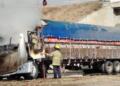
The constant blockades by farmers at border points and highways in Ciudad Juárez, Chihuahua, which have occurred in the last two weeks due to the lack of agreements with the federal government on the Water Law , generated major economic and logistical problems.
In an interview with T21, Manuel Sotelo , vice president of the northern region of the National Chamber of Freight Transportation (Canacar) , warned that the blockades paralyzed goods with an estimated value exceeding two billion dollars (mdd) , affecting the maquiladora industry that operates mainly through this border crossing.
Sotelo noted that, according to U.S. Customs data, each shipment has an average value of $65,000, and at least 7,000 shipments cross the border daily, including both exports and imports. Last week alone, with four days of closures, the value of the goods that failed to cross on time reached $1.3 billion . This week, with three days of closures, approximately 17,500 shipments were held up, representing $1.137 billion.
Sotelo recalled that the previous week the city faced four days of total isolation. Protesters blocked key border crossings such as Guadalupe-Tornillo, Zaragoza-Ysleta, Córdoba de las Américas, and Jerónimo-Santa Teresa , as well as highway access to the north and south, leading to shortages of gasoline and basic goods.
In contrast, this week the blockades were concentrated solely at border crossings, leaving the routes south open, which served as alternatives for diverting goods to Nogales or Laredo. However, costs and transit times skyrocketed: a crossing that normally takes two hours and costs $150 to $200 became a journey of up to two days and more than 100,000 pesos per unit .
Regarding customs, Sotelo explained that there is a delay of between seven and ten days for the flow of goods to return to normal. However, it was agreed that customs will extend its operating hours, which will expedite the flow and reduce accumulated delays.
The vice president of Canacar lamented that a region strategic for binational trade is being hit by the lack of agreements and pointed out that the protesters chose Chihuahua because “Ciudad Juárez is the number one manufacturing exporter in the country.”
“We are pleased that the federal government is doing its part. It is not fair that a region should be so negatively affected because they cannot reach an agreement with one economic sector of the country,” he emphasized.
On Friday morning, farmers withdrew from the Zaragoza–Ysleta, Guadalupe–Tornillo and Jerónimo–Santa Teresa border crossings, which had been blocked since December 2.
According to data from the United States Bureau of Transportation Statistics (BTS) , in the period January-August 2025, trade was recorded for 581,306 million dollars, of which 72,975 million dollars were through the Juárez-Ysleta International Bridge , consolidating it as the second most dynamic crossing, after Nuevo Laredo-Laredo, with 229,738 million dollars in the cycle.
Comment and follow us on X: @miroslavacs / @GrupoT21