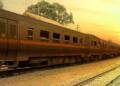
The Railway Transport Regulatory Agency (ARTF) reported that of the 750 kilometers (km) planned for passenger trains, only 1% will have an interaction with the current freight tracks , which will be at night, and also detected that they will have to acquire 10% of the right of way for these projects.
Andrés Lajous, director general of the ARTF, reiterated that dedicated lanes will be built for the exclusive use of this service.
“We have the existing freight line, which has its small embankment, and the two passenger lines are being built in parallel. Not all sections have passenger lines, depending on the distances between stations and demand. There will be sections where there is only one passenger line, such as section 6 of the Mayan Train,” he indicated during his participation in this Wednesday’s morning press conference.
It’s worth remembering that in mid-May, the ARTF reported that a mixed operation would be carried out on only five kilometers of land, due to terrain classified as “extremely difficult.” These kilometers would be part of the first four projects and are located along the Mexico-Querétaro train route.

Lajous explained that they found that of the 750 km, 89% are dedicated roads with shared right-of-way, while 10% are in the process of acquiring right-of-way to allow for faster travel.
He explained that the trains will run at speeds between 160 and 200 kilometers per hour (km/h) and in some cases, such as the Felipe Ángeles International Airport (AIFA ) – Pachuca and the Suburban Train to AIFA, they will be electric, while in the rest they will be diesel-electric.
Likewise, there will be main and secondary stations, with the goal of offering more regional services, which is why the architecture department of the Ministry of Infrastructure, Communications, and Transportation (SICT) has been working on their design.
He also reported that demand studies have allowed for the identification of certain intercity and regional services, such as the Querétaro-Irapuato route, where there are a significant number of business trips between San Juan del Río and Celaya.

Regarding the bidding process, Lajous stated that interested builders must demonstrate their ability to prepare the executive project and other aspects related to this type of plan, as outlined in the tenders.
He stated that there are areas where bridges will need to be built due to the terrain, but also to avoid urban areas and to avoid interaction with cargo, so they will be used over these roads, as is the case in the industrial zone of Monterrey.
He recalled that in the case of the bidding process for the first 30 km of the Querétaro-Irapuato line, the decision will be made between the second and third week of August , and in the following days they will publish the call for bids for a 70 km stretch from Apaseo to Irapuato.
The official explained that on this stretch, traffic will run parallel to the freight service, although there is a detour to take the right-of-way of Highway 45D, then continue through Salamanca and rejoin for the entrance to Irapuato. He added that in Celaya, the freight train will not cross the city but will use the bypass.
Meanwhile, for the Saltillo-Nuevo Laredo route, the decision will also be made between the second and third week of August . In terms of the bidding process, he emphasized that there are approximately 250 km of bidding available in total.
Regarding the Mexico-Pachuca line, he said it has an estimated 100,000 daily passengers along the entire route, including the sections from the State of Mexico to the AIFA (National Highway Administration), toward Hidalgo, and Tizayuca, Empalme del Rey, and Pachuca.
For this reason, the tender for 15 passenger trains is underway , which will have a maximum speed of 130 km/h. He also specified that, due to high demand, the capacity of the units will be increased, and instead of having a 100-meter train every six minutes, there will be a double train every six minutes during rush hour.
The trains will carry 700 passengers, offer universal accessibility and priority seating. The call for proposals will be published this Thursday, with the decision announced at the end of August .
From ARTF to the Integrated Train and Public Transport Agency
Andrés Lajous explained that the creation of the Integrated Public Transport and Trains Agency (ATTPI) aims to prioritize passenger trains as part of national development and strengthens the role of the Mexican State, as it gives it specific powers for the planning and design of passenger services, but also reinforces rail freight transport to organize existing concessions .
Furthermore, the powers for better coordination, managing concessions, and overseeing national assets, such as the current railway infrastructure, are established “more clearly.”
Lajous explained that before the creation of the new agency, there were actions that were divided or duplicated between the ARTF and the General Directorate of Railway Development, so they will now be under a single agency.
Therefore, now with the ATTPI, which is a decentralized public agency but under the supervision of the SICT, the planning, construction, maintenance, modernization, regulation, and design of the national railway system and multimodal transportation, as well as public transportation, will be carried out.
Comment and follow us on X: @evandeltoro / @GrupoT21