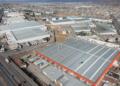
The Mexican Association of Private Industrial Parks (AMPIP) announced at its first meeting and General Assembly 2026 the commissioning of the first 20 industrial parks , which are part of the 100 planned in the Mexico Plan of the federal government.
“The delivery of these first 20 parks is not just a number, it is proof that we are working in coordination with the Government of Mexico for the industrial and economic development of the country,” said Claudia Esteves, general director of AMPIP.
The event was led by Altagracia Gómez, coordinator of the Advisory Council for Regional Economic Development and Relocation (CADERR), who presented awards to 15 real estate developers responsible for the urbanization and construction of these spaces in coordination with the Government of Mexico .
The impact indicators for this first phase include an investment exceeding $711 million, the development of 3.5 million square meters of industrial space , the projected establishment of 245 companies, and the estimated creation of 62,000 direct jobs. The industrial parks are located in 10 key states, including Baja California, Mexico City, Chihuahua, Jalisco, and Nuevo León, with infrastructure that facilitates access to national and international markets.
AMPIP noted that, just over 500 days into Claudia Sheinbaum’s administration, it has effectively addressed regulatory obstacles in coordination with the federal government, and stressed that developers, in response, have implemented operational infrastructure that strengthens competitiveness in light manufacturing and logistics .
Furthermore, the organization indicated that it aims to provide spaces that allow industries to operate continuously, safely and efficiently, integrating into national and global value chains.
The Mexico Plan envisions the development of 100 industrial parks with the goal of strengthening productive infrastructure , attracting domestic and foreign investment, and consolidating new opportunities for economic growth. The strategy seeks to create conditions for the establishment and operation of manufacturing and logistics companies, with spaces that facilitate the integration of national and global value chains.