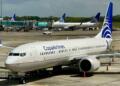
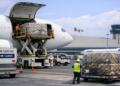
The at-risk category and impact on passenger and cargo traffic are part of the impact that the measures announced by the United States against Mexico will generate for alleged noncompliance with the Air Transport Agreement signed in 2015 and its continued anticompetitive behavior since 2022.
Juan Antonio José, an independent aviation analyst, considered the aviation policy decisions of the previous six-year term to be a “blow” to the agreement, and gave “genuine and legitimate reasons to Donald Trump, president of the United States, to complain about the country.”
In an interview with T21, he explained that the measures will limit the expansion of Mexican airlines into the United States , increase bureaucracy, as well as the deterioration of finances in Mexican operators, and seriously jeopardize the strategic alliance between Delta and Aeroméxico .
“The risks we face are that Aeroméxico loses its antitrust immunity, that the United States denounces the bilateral agreement and says it’s withdrawing from the civil aviation agreement, and then sets its own rules. There’s also a potential audit by the FAA (Federal Aviation Administration) that could demote Mexico again. This will prevent Mexican airlines from growing in the US market, which will be more restricted in terms of processing with the DOT (United States Department of Transportation) ,” he said.
It should be recalled that then-President Andrés Manuel López Obrador decreed the move of dedicated freighters from Mexico City International Airport (AICM) to Felipe Ángeles International Airport (AIFA) in 2023, citing the saturation of the former, in addition to the reduction in operations for the same infrastructure from 61 to 49 per hour.
Juan Antonio José said that in terms of air cargo, those affected by the 2023 cargo decree were DHL , UPS and Atlas Air .
For his part, Ricardo Dadoo, president of Logistics Dadoo , indicated that a disadvantage of sending the freighters to AIFA was the impact on the package integrator UPS , as the only American carrier forced to relocate, since FedEx operates from a third airport, Toluca.
He explained that UPS had “ideal time slots” from 7:00 a.m. to 7:30 p.m. at AICM, schedules that had to be substantially shortened after the move to Felipe Ángeles , while costs increased as the distances for ground transfer feeders grew, in addition, customs intermediation became slower, adding that it now subcontracts warehousing instead of operating the concessionaire at the capital’s airport, and where it made a considerable investment in equipment and automation “until the unwanted movement.”
“What’s wrong is that air cargo logistics is different from that of small express packages, and the local government didn’t take this into account. It didn’t distinguish, perhaps due to a lack of understanding between the two business models (starting with short D2D times plus air volume density), with the misconception that all cargo planes are the same. UPS presented its case in vain. The AIFA has benefited the former to the detriment of the latter,” he said.
However, he explained that international air cargo tonnage has grown by almost 50%, from 440,000 tons to 640,000 tons LTM by March 2025, including the volume collected by the AICM and AIFA.
“Thanks to the first-world infrastructure and the 24/7 availability of the slots offered at AIFA, Mexico City now ranks second in Latin America in tonnage. Gradually, its volume from Central and South America to Asia has reduced transit times by one or two days without going through Los Angeles. A feat impossible within AICM’s cargo infrastructure,” he said.
New actions by the US
Last Saturday, U.S. Transportation Secretary Sean Duffy announced a series of measures against Mexico’s alleged abuse of the bilateral aviation agreement.
He indicated that Mexico abruptly rescinded slots ( takeoff and landing times) at the AICM and forced U.S. cargo carriers to relocate their operations as part of the effort to alleviate congestion. This has not materialized three years later, causing cost increases for U.S. airlines.
“That ends today. Let these actions serve as a warning to any country that thinks it can take advantage of the United States, our operators, and our market. America First means fighting for the fundamental principle of fairness,” he said in a statement.
Therefore, it imposed three actions: Mexican airlines must submit applications to the DOT for all their operations in the United States, in addition to requiring prior approval for any charter flight of large passenger or cargo aircraft to or from this country , and the withdrawal of antitrust immunity (ATI) between Delta and Aeroméxico, thus taking corrective measures to address competitive problems in the market.
“Mexico’s actions harm airlines seeking to enter the market, existing competing airlines, consumers of air travel and products that depend on time-sensitive air cargo shipments traded between the two countries, and other stakeholders in the U.S. economy,” he stated.
The U.S. agency stated that it “reserves the right to reject flight requests from Mexico if the country does not take corrective measures.”
Against this backdrop, the Ministry of Infrastructure, Communications, and Transportation (SICT) stated that the actions it has taken at AICM and AIFA have served to strengthen the airport system in the Valley of Mexico. “Measures have been implemented to improve the safety, efficiency, and competitiveness of the aviation sector.”
Comment and follow us on X: @evandeltoro / @GrupoT21