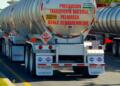
The Mexico City government announced a series of reforms to the traffic regulations aimed at strengthening safety in the transportation of hazardous materials , following the accident that occurred on the Concordia Bridge on September 10, which left 31 people dead.
At a press conference, Mayor Clara Brugada presented 13 new regulations grouped into four categories: routes, schedules, speed limits, and roads permitted for the transportation of hazardous materials. Among the most significant measures are a traffic ban for vehicles transporting more than 40,000 liters of toxic materials or hydrocarbons, and stricter fines for noncompliance with the guidelines.
These actions aim to prevent future incidents and ensure safer mobility in the capital. The main measures include:
- Speed limit : Reduced to 30 km/h for vehicles transporting hazardous substances.
Circulation hours :
- Less than 10 thousand liters: all roads from 10:00 a.m. to 6:00 p.m.
- Between 10,000 and 20,000 liters: only primary roads from 10:00 a.m. to 6:00 p.m.
- Between 20,000 and 40,000 liters: primary roads from 10:00 p.m. to 5:00 a.m.
- More than 40,000 liters: driving in the city is prohibited.
Brugada also indicated road restrictions for vehicles transporting hazardous materials such as:
- Circulation on secondary roads is prohibited for tankers carrying more than 10,000 liters of hydrocarbons.
- Traffic is prohibited on controlled access roads such as Periférico, Circuito Interior, Viaducto, Calzada Ignacio Zaragoza, Constituyentes, and Calzada de Tlalpan.
- Mobile radars at the five access points to Mexico City: Mexico City-Pachuca, Mexico City-Puebla, Mexico City-Querétaro, Mexico City-Toluca, and Mexico City-Cuernavaca.
- Random checkpoints to verify regulatory compliance.
The head of government also indicated that there will be requirements related to licensing procedures, training, and certifications for the handling of hazardous materials transportation, including:
- Hazardous substances handling course and training certificate endorsed by the Ministry of Communications and Transportation (SICT) to obtain the E12 license.
- Technical opinion by a verification unit authorized by the Ministry of Energy (Sener) for transportation permits in accordance with NOM-007-SESH-2010 .
- Opinion authorized by the Agency for Safety, Energy and Environment (ASEA) for vehicle control.
- Specific guidelines for internal Civil Protection programs .
For his part, the head of Mexico City’s Citizen Security Secretariat , Pablo Vázquez, stated that the collaboration and participation of citizens and businesses will be essential to prevent these types of incidents.
Among these collaborations, Vázquez noted that there will be agreements with Sener and ASEA for joint operations and invited citizens to file complaints in case of irregularities.
Comment and follow us on X: @GrupoT21