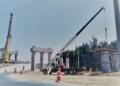
Turning Baja California ‘s geographic location into a sustainable competitive advantage is one of the central pillars of the economic planning strategy promoted by the state government, with a vision that integrates logistics, energy, and territorial development beyond political cycles, explained José Saúl de los Santos Gómez, Undersecretary of Economic Planning for Baja California and Director of the State Port Administration .
From the Ministry of Economy and Innovation , the state is working on consolidating a state logistics system , focused on articulating infrastructure projects and coordination with the private sector.
“We have a key location towards the United States and the Pacific coast, but that comparative advantage only becomes competitive to the extent that we accompany it with infrastructure and planning,” said De los Santos Gómez.
One of the flagship projects of this vision is the Punta Colonet port , whose development has been underway for more than four years. The official explained that in 2024 the Environmental Impact Statement was approved, and subsequently, the 50-year concession was granted , thus opening up a long-term project.
“This allows us to envision a three-stage development over a decade for a deep-water port with an estimated capacity of 4.8 million TEUs (20-foot containers) , in addition to general cargo, mineral bulk and energy terminals,” he noted.
He stressed that these types of projects require close coordination between the different levels of government , particularly with federal agencies such as the Ministries of Energy (Sener) , Navy (Semar) , Infrastructure, Communications and Transportation (SICT) and Economy (SE) .
“Energy and logistics infrastructure projects are long-term; they easily take four or five years of planning , plus two or three years of development , which exceeds a single administration,” he explained.
In this context, energy planning becomes a key component. The undersecretary clarified that it is not only about ensuring the volume of available energy, but also about guaranteeing its proper allocation.
“It’s not just the volume of energy, but its location within the territory; if we need it in Tijuana, Mexicali, San Quintín or Ensenada, that implies very precise geographical planning,” he stated.
This strategy is complemented by other projects such as the New Otay II Border Crossing , airport, rail and road schemes, which must be integrated as an interconnected system.
“All of this is happening in different places, and the challenge is to get them connected,” the official noted.
The boost to logistics infrastructure is occurring within a favorable economic environment for the state. According to the Baja California Economic Outlook , the state ranked eighth nationally in the Quarterly Indicator of State Economic Activity during the second quarter of 2025, with an index of 109.5 .
The state’s export-oriented focus also reinforces the need for this planning. According to the same document, in the third quarter of 2025 , Baja California registered exports of $14,145.8 million , ranking as the fourth largest exporting state in the country , with a 9.3% share of the national total .
The available figures on the manufacturing structure show a high concentration of economic value in technology- and capital-intensive subsectors. The manufacture of computer, communication, and measurement equipment accounts for $156 billion , followed by the manufacture of transportation equipment with $90 billion , while other manufacturing industries contribute $71 billion .
In terms of foreign capital inflows, the state attracted US$1.549 billion in Foreign Direct Investment (FDI) through the second quarter of 2025, representing 4.6% of the national total , according to figures from the Ministry of Economy cited in the Economic Outlook. Of the total, 64.3% corresponded to reinvested earnings , reflecting the continued presence of capital already established in the state, despite a 26.8% year-on-year decrease in accumulated flows.
The undersecretary acknowledged that one of the main challenges going forward is geopolitical uncertainty , particularly due to its impact on investment decisions.
“There is uncertainty in investment flows and in the priority given to certain sectors, as we have seen at the national level in the automotive industry,” commented De los Santos Gómez, although he clarified that, while Baja California has a presence in this sector, it is not its main economic engine.
Another significant challenge is political transitions , and the state seeks to safeguard its projects through planning instruments. “Our best weapon is to enshrine these elements in plans and programs that transcend administrations,” he stated.
In that regard, he explained that the State Urban Development Plan is being reviewed to incorporate industrial growth zones, logistics corridors, and energy hubs that provide certainty to investors.
Within this territorial vision, he highlighted the potential of the Ojos Negros Airport , east of Ensenada, an infrastructure that is not very visible on the national logistics map.
“It is an airport with a runway of more than four kilometers , with conditions to receive cargo planes, and whose concession belongs to the state,” he stressed, which opens the possibility of developing logistical operations that contribute to decongesting the Tijuana metropolitan area.
The weight of the productive sector is also reflected in employment. Data from the Mexican Social Security Institute (IMSS) and the Manufacturing, Maquiladora and Export Services Industry Program (IMMEX) , included in the Economic Panorama of Baja California, indicated that manufacturing accounts for more than 429,000 formal jobs in the state, while IMMEX establishments employ 349,314 people , with Tijuana as the main industrial hub.
For this strategy to materialize, the state official considered it essential to move beyond coordination towards alignment between government, private sector and academia.
“Coordination means reaching an agreement; alignment means that actions add up: public infrastructure, private investment, and talent development,” he explained.
Looking ahead two or three years, the undersecretary said he would like to see phase one of the Punta Colonet port in operation , progress on Otay II , and a substantial improvement in the state’s energy balance.
“The availability of more electricity and natural gas would be a game-changer, because it would allow us to attract industries that do not currently consider Baja California,” he stated.
These advances, he concluded, would lay the foundation for a sectoral and territorial diversification of Baja California’s economic development, reducing the concentration in the Tijuana metropolitan area and opening new opportunities for other regions of the state.
Comment and follow us on X: @karinaquintero / @GrupoT21